On a beach in Jeju I once watched the waves for about 20 minutes. I did nothing at all, and on the way back my head was strangely light. Until that day I'd thought resting meant scrolling short-form on the couch. That was the day I learned those two are entirely different things.
Mulmeong is a Korean word, water plus spacing out, for time spent gazing at water while thinking of nothing. While you space out, the brain doesn't power down. The parts that process outside stimulation go quiet, and the parts that file your inner world switch on. The phone runs the exact opposite pattern, which is why scrolling feels like rest and isn't. And with no ocean nearby, a window or a candle builds the same time.
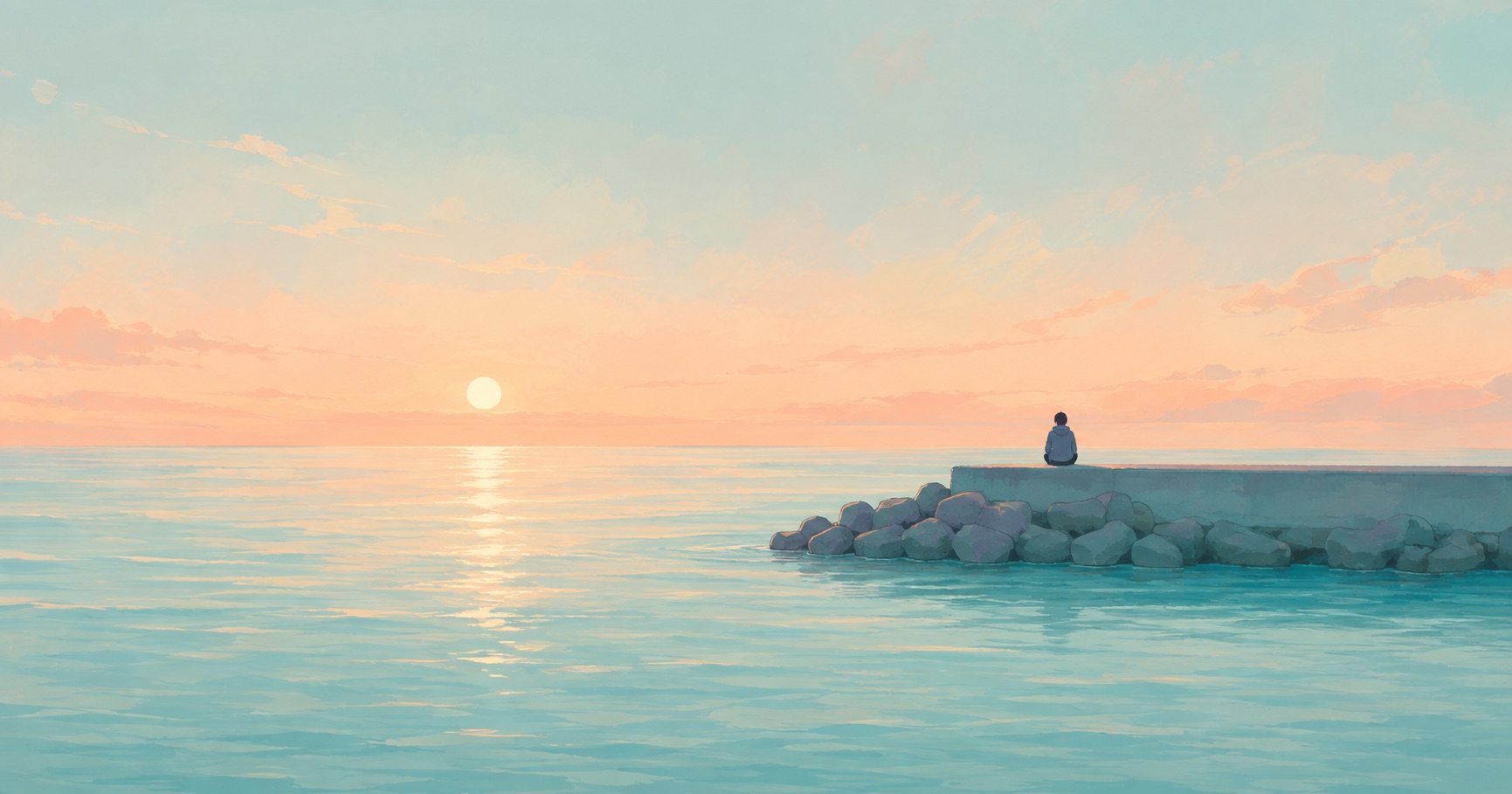
Mulmeong joins two Korean words: mul, water, and meong, the state of blank staring. It covers gazing at the sea, a river, a lake, an aquarium, even water running from a tap, while thinking of nothing in particular. The suffix travels: bulmeong is fire-gazing, supmeong is forest-gazing. In Korea the word has grown familiar enough to name cafés and travel packages, which says something about how many people need exactly this kind of time.
Water fits the job unusually well. It moves constantly, so the eyes never get bored, and the movement means nothing, so the head has nothing to interpret. Something to see, nothing to read. It holds the eyes and releases the head. That's the structure of mulmeong.
Neuroscience groups the regions that grow active when you're doing nothing under the name default mode network. The name is heavy; the idea is simple. It's the state the brain returns to when nothing outside demands focus. In that state, the head files the day's events, sketches what's ahead, and joins up scattered thoughts.
| State | Outside processing | Inner filing | How it feels |
|---|---|---|---|
| Working, studying | On | Off | Focus, fatigue |
| Scrolling short-form | On, refreshed every few seconds | Off | Feels like rest, leaves fatigue |
| Mulmeong, spacing out | Nearly off | On | Lightness, drifting thoughts |
| Sleep | Off | Partly on | Recovery |
The table shows it: scrolling and mulmeong are opposites. Both happen on a couch, so they feel alike, but inside the head, one is working and one is resting. The lightness I felt on that beach was 20 minutes of inner filing allowed to run.
The phone feeds outside stimulation without pause. Short-form especially delivers a new scene, new sound, new text every few seconds, so the outside-processing parts never get a gap. The body lies still while the head takes dictation.
I didn't know this for years. Exhausted after putting my kid to bed, I'd scroll, and feel worse after, and not know why. I had been working in a resting position. Spacing out runs the other way: boring at first, lighter after.
Mulmeong isn't a cure-all. In a heavily worried season, the inner filing can drift into replaying the same worry. That's when an eye-holding object matters most, which is why water-gazing is easier than bare spacing out, and why a set end time helps.
Even watching water, the hand drifts phoneward. Start a dive in Sumbi and lay the phone face down, and your remaining breath shrinks only while another app opens, with the screen off never breaking the dive. Finish the gazing, finish the dive, and one shell opens with a sea creature inside.
Try your first 10-minute dive →If the sea is far, substitutes abound: the tree outside the window, a candle, an aquarium, a kettle coming to a boil, the sound of rain. One test: it moves, and the movement means nothing. Television moves but means, so it fails. A wall means nothing but doesn't move, so it's hard mode. Mine is the tree past the balcony glass.
Twenty minutes runs long at first. Start at ten, phone in another room. Within reach, every bored moment sends the hand over. My phone lives in the living room drawer after 9 p.m., so sitting on the balcony afterward turned into the habit by itself.
They will surface. No need to block them or follow them. Let them rise and pass. The daycare bag can be written down later; the worry passes too. The water helps here: when a thought starts to catch, the eyes drift back to the water, and the thought lets go.
Wake the phone right after and you pour stimulation straight onto a freshly filed head. A glass of water, one stretch, then the phone: still not late. Those few minutes are what let the gazing keep its work.
One line from a phone-down day. So many nights I worked in a resting position. Twenty minutes of waves taught me the difference, and now the tree outside the window does that job.
This article is general information, not medical advice. If sleep or daily life stays disrupted, talk to a professional.
Scan the QR with your phone to open the install page.
 Sumbi
Sumbi