I believed I was an evening person. I spent evenings on my phone, so I figured I must be wired awake at night. A week of writing it down said otherwise: my focus lived in the morning, and the evenings were just tiredness with a phone in it. What I knew and what I measured didn't match.
You find your focus hours by rating your concentration 1 to 5 on paper, every two hours, for one week. Paper, not an app, because waking the phone to log turns the log into phone use. Average by time slot and two or three high stretches appear: those are your hours. Overlay your phone's hourly usage and the phone usually clusters in the low-focus hours, which may mean the phone isn't lowering your focus so much as your low hours are calling for the phone.
Ask people their best focus hours and most answer morning or night, and measurement often disagrees. Memory skews toward the dramatic days, and hours spent scrolling out of tiredness get misfiled as hours of being awake. Human alertness rhythms sit somewhere on the morning-to-evening spectrum and drift with age and circumstance. So writing beats asking.
| Slot | Mon | Tue | Wed | Thu | Fri | Avg |
|---|---|---|---|---|---|---|
| 7 to 9 | 3 | 4 | 3 | 4 | 3 | 3.4 |
| 9 to 11 | 5 | 4 | 5 | 5 | 4 | 4.6 |
| 11 to 13 | 3 | 3 | 4 | 3 | 3 | 3.2 |
| 13 to 15 | 2 | 2 | 2 | 3 | 2 | 2.2 |
| 15 to 17 | 3 | 4 | 3 | 3 | 3 | 3.2 |
| 17 to 19 | 2 | 2 | 3 | 2 | 2 | 2.2 |
| 19 to 21 | 2 | 3 | 2 | 2 | 2 | 2.2 |
| 21 to 23 | 1 | 2 | 1 | 2 | 1 | 1.4 |
The table is an example. This person peaks 9 to 11 and bottoms out past 9 p.m. It looked a lot like mine, the one that ended my evening-person theory.
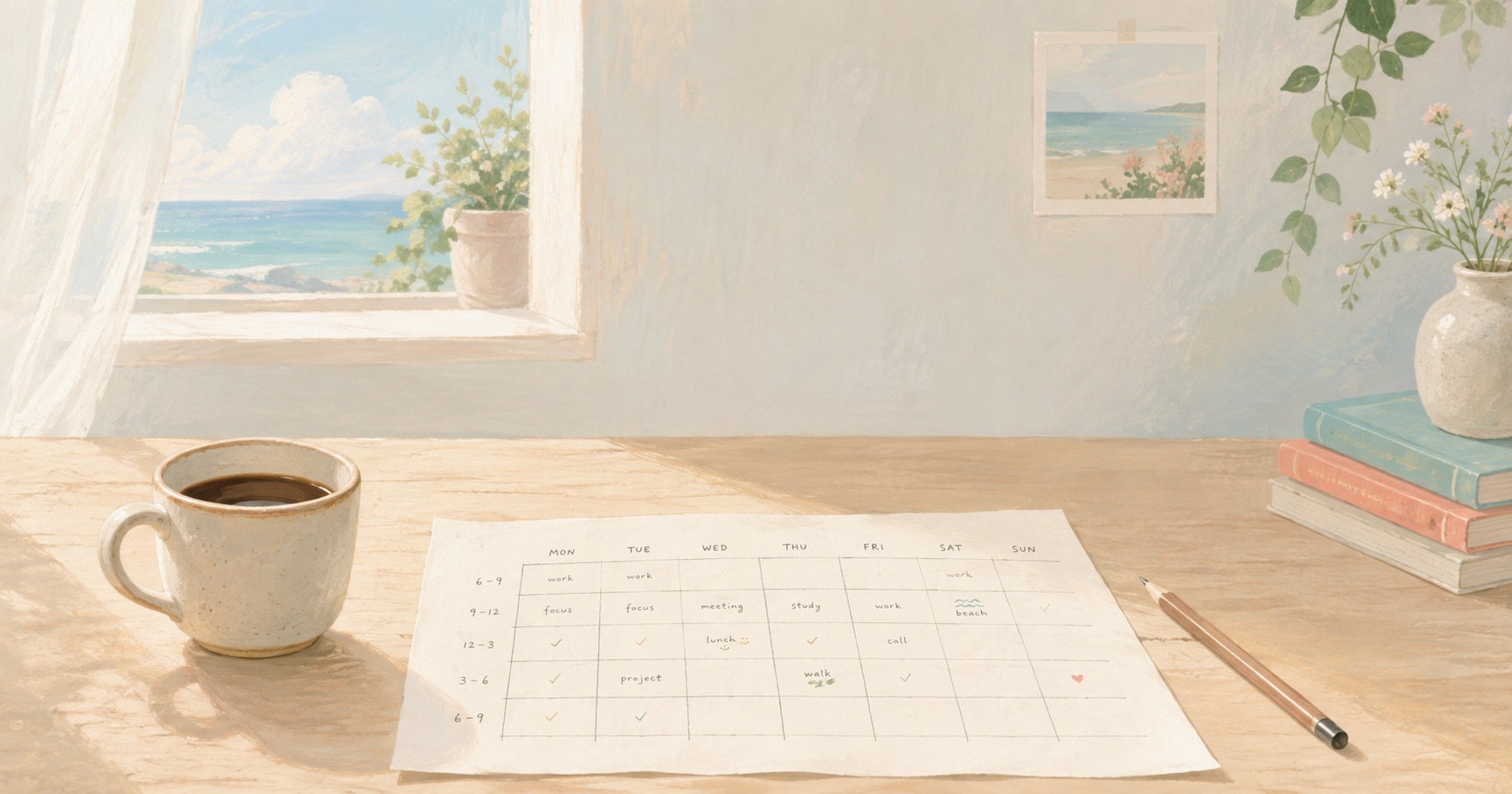
Draw the grid on one sheet. Divide waking hours into two-hour slots, and in each, write the focus of that stretch, 1 to 5. Keep the scale blunt: 5 means time disappeared, 3 means ordinary, 1 means nothing worked. Don't batch-fill in the evening, memory warps. The sheet lives on the desk, one box every two hours.
After the week, open your phone's screen time page to the hourly view and set it next to the sheet. Usually the phone piles into the low-focus slots. Two readings are possible: the phone lowered the focus, or the low hours reached for the phone. Mostly it's both. Mine clustered at 1 to 3 p.m. and after 9, and those hours were low with or without a phone. So instead of fighting the phone there, I put focus-free work in those slots and cleared the phone out of the mornings only.
The best thing the overlay gave me was less self-blame. Seeing that 2 p.m. scrolling wasn't weak will but a naturally low hour, a walk or some tidying was enough to put there. Sorting the hours worth fighting for from the ones that aren't: that's what the sheet is for.
Scrolling in a low-focus hour isn't a failing. But when that hour sits before bed, it cuts into sleep, so the night's low hours are better filled with sleep than with the phone.
A dive in Sumbi can start at any hour, and night dives meet the creatures that sleep through the day. Put a dive in your high-focus hours and those hours get protected. Put one in the low night hours and that time goes to sleep instead. Either way, one shell remains.
Build your own sea →Into the two highest hours goes the day's single hardest task. That's where the deep work block lives, phone in another room, messenger closed. Protect just those two hours and the rest of the day changes shape.
Email, tidying, replies, errands go in the low slots. Attempt hard work there and the phone comes out and the self-blame follows. Low hours used as low hours are used well.
Rhythms move, with seasons, with work, with a kid's schedule. This is something I learned as a parent: when my kid started sleeping earlier, my whole evening column changed. One week of writing, once a month, keeps the map current.
One line from a phone-down day. Seeing that past 9 p.m. was my lowest box made the drawer stop feeling like a sacrifice. Those hours were never going to focus anyway.
This article is general information, not medical advice. If sleep or daily life stays disrupted, talk to a professional.
Scan the QR with your phone to open the install page.
 Sumbi
Sumbi