Have you ever counted how many times a day you hear ten more minutes? I did once: six. The number I assigned became a daily negotiation, and the daily loser was me. Then I flipped the order and had my kid propose first, and ten-more-minutes nearly disappeared. Here's the sequence.
The daily game-time negotiation repeats because a parent-assigned number is, to the kid, an opening bid rather than a decision. The game becomes how much more can be extracted from it. Flip the order: the kid proposes the number, the parent attaches only conditions, and a self-proposed number leaves little to renegotiate. And hang the stopping point on the round ending, not the clock. That's the version that lasts.
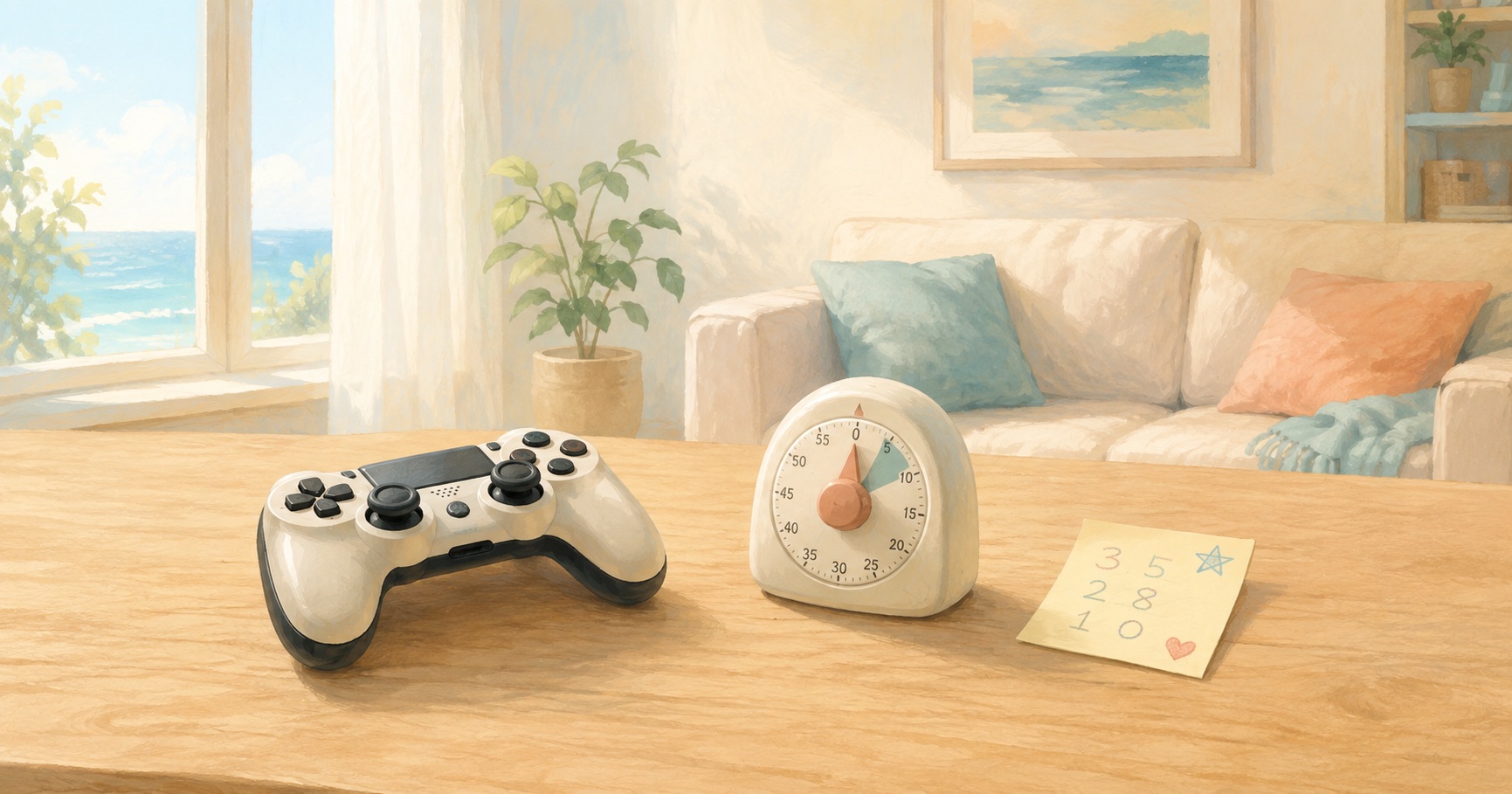
Say 30 minutes and a kid hears not a decision but a first offer. Negotiation starts there. If ten-more works, tomorrow opens at 40. If it doesn't, tears are the next card. The daily rerun isn't a bad kid. It's a kid who learned the parent's number is negotiable.
And games don't end on clock time. When the timer fires mid-round, the kid experiences it as having the thing taken. Adults get angry too when the movie gets shut off five minutes early. Cut by clock alone, and this collision reruns nightly.
The core: the kid says the number first, and the parent attaches conditions instead of trimming the number.
My kid opened with a hundred minutes. I wanted to trim it, held on, and said fine, after homework and before dinner. Homework-to-dinner is about 40 real minutes, so a hundred was never physically possible. My kid believes the hundred was honored. I got my 40. Both things are true.
| Age | The kid decides | The parent conditions | The ending signal |
|---|---|---|---|
| 5 to 7 | How many rounds | When, and where | A timer, the agreed round count |
| Early elementary | Daily minutes | Sequencing: after homework, before dinner | The round that's running |
| Upper elementary | Daily minutes and the slot | Nights excluded, weekends separate | A time the kid set |
| Middle school and up | Weekly total and its split | Sleep stays untouched | The kid, unprompted |
As age rises, the kid's territory widens and the parent's conditions shrink. Assign round counts to a middle schooler and the assignment itself becomes the fight.
A buddy in Sumbi is a partner in the same dive. While the kid plays their 40 minutes, two parents can run a 40-minute buddy dive, making it a house where the kid keeps a time and the parents are visibly off their phones for it. The time fills, word reaches each other, and the kid gets told: you're not the only one keeping a rule here.
Start as buddies →When the timer rings, the running round gets finished. The trade: no new round starts. Nothing gets ripped away, so the tears thin out, and no new rounds means the time barely stretches. This one change took our six daily ten-mores down to about one.
As it ends, say: tomorrow, after homework, you can play again. A kid clings because today might be the last time. With tomorrow guaranteed, ending today gets easy. The kid stops experiencing it as losing the game and starts experiencing it as pausing it.
Trim today because yesterday ran over, and the kid doesn't regret yesterday. The kid resents today. Broken days get a short word that night and end there, with tomorrow at full size. If it keeps repeating, the weekly sit-down comes early and the kid re-proposes the number.
Our game time now is the one my kid defined: after homework, before dinner. In minutes it's about 40, and my kid considers it self-chosen. And for those 40 minutes, I don't touch my phone beside them, because it can't be a rule only the kid keeps. One line from a phone-down day. During the time my kid set, I put mine down too.
This article is general information, not medical advice. If sleep or daily life stays disrupted, talk to a professional.
Scan the QR with your phone to open the install page.
 Sumbi
Sumbi