For one week I wrote down why I took my phone out. Checking the time, the alarm, a note, a calculation, a photo, the weather. Short-form was only one item on the list, yet the phone I took out for the other reasons kept ending up there. So I started handing the reasons, one by one, to other objects.
A phone isn't a single object. It's a box holding ten tools, and checking the time ends in short-form because the clock and the short-form live in the same box. Set up just three separate objects, an alarm clock, a wristwatch, and a paper notebook, and the number of times you take the phone out drops visibly. The whole set costs little, and the right order to switch starts with the things you use at night.
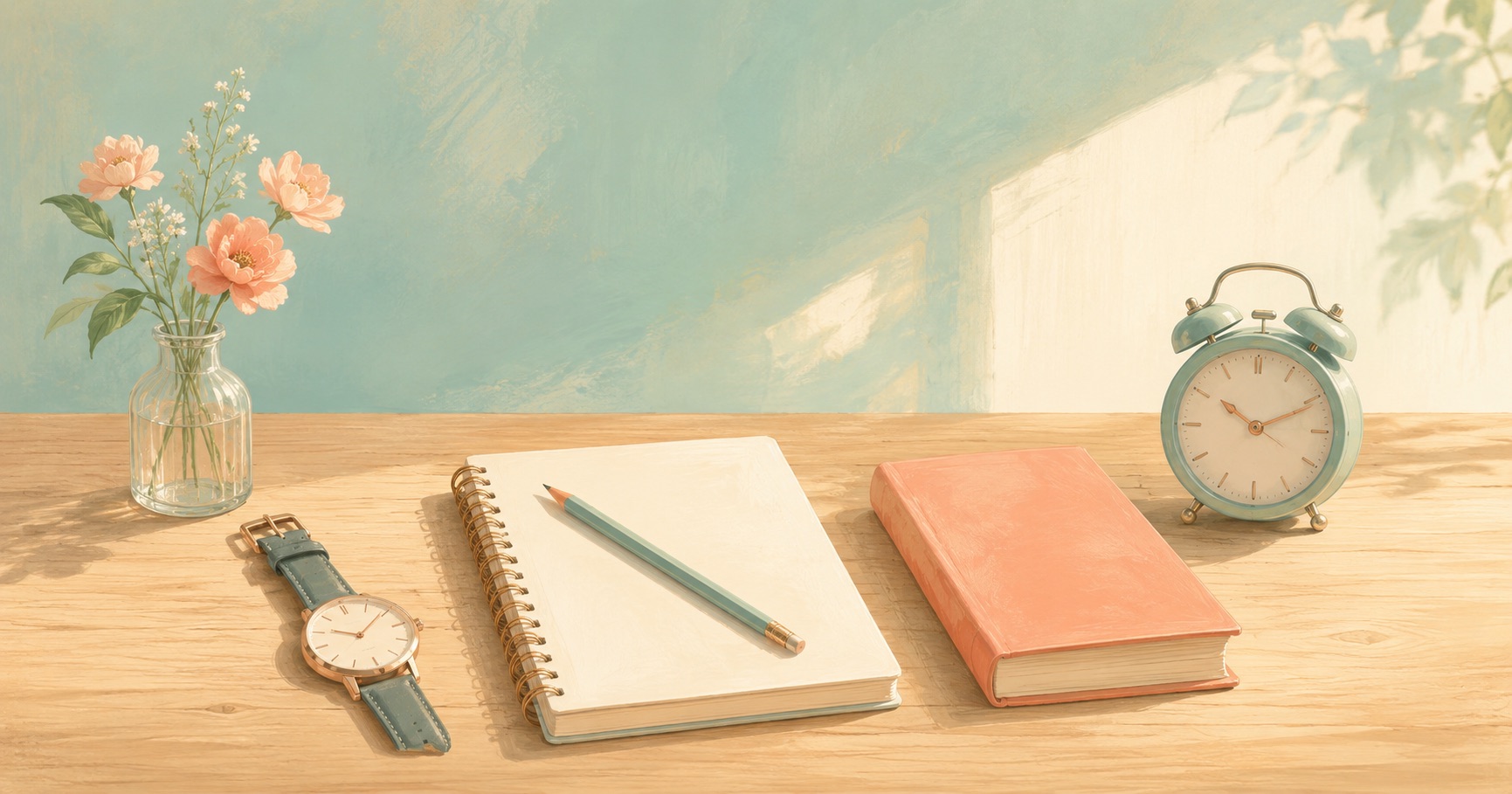
The reasons we light up the phone are mostly small. What time is it, what's tomorrow's weather, let me jot the grocery list. But the moment it lights up, notifications are on the screen, notifications open apps, and apps eat 20 minutes. Checking the time and ending at short-form isn't weak will. It's the clock and the short-form living in the same box.
My week of logging came to about 40 pickups a day, and fewer than ten were to see short-form or social feeds. The other thirty were the small reasons, time, alarm, notes, math, and half of those thirty ended in short-form anyway. Erase the small reasons and half the big problem disappears with them.
| Phone function | Replacement | Cost | What changed |
|---|---|---|---|
| Alarm | Alarm clock | $10 to $25 | Phone leaves the bedroom. Biggest effect |
| Checking the time | Wristwatch, wall clock | From $20 | Daily pickups cut in half |
| Notes, to-dos | Paper notebook, fridge memo board | A few dollars | No more detours on the way to jot something |
| Reading | Paper books, e-reader | Book money | The hour before bed transforms |
| Photos | A small camera | Used, from cheap | Travel and kid photos feel different |
| Music, audiobooks | Small speaker, radio | From $20 | Playable without the phone |
| Calculator, timer | Kitchen timer, desk calculator | A few dollars | No phone during cooking |
| Maps | Paper maps | Free to cheap | Travel only. Daily life, the phone wins |
| Weather | The window, morning TV news | Free | The morning's first phone disappears |
Not everything needs replacing. Daily maps belong on the phone, and payments and authentication can't leave it. The three at the top carried the effect: alarm clock, wristwatch, notebook. Those three erase most of the reasons the phone comes out.
Buy everything at once and half of it lands in a drawer within days. One at a time, starting with the night.
Buying the object doesn't change the habit. Placing it where the phone used to be does. The watch goes on the wrist by the phone pocket, the notebook takes the phone's old spot on the table. The hand goes where it always went, and finds something else there.
Once the alarm clock and the wristwatch do the phone's jobs, the reasons to open it run out, and Sumbi's dive can fill the time that's left. Start an evening dive, put the phone in the drawer, and your remaining breath shrinks only while another app is open. Finish, and a shell opens with a sea creature inside. The objects erase the reasons. The dive keeps the time.
Start this evening's dive →A year on, still in use: the alarm clock, the wristwatch, the notebook, and a small speaker. All four sit where the phone used to. The film camera comes out for trips, and the paper map lives in the travel bag. The kitchen timer got claimed by my kid as a toy, which is also fine.
The e-reader never took. Paper felt better and I kept forgetting to charge it. The desk calculator never found a moment. Unused objects are normal. Buy ten, keep four, and you bought well.
The first thing I see in the morning became an alarm clock instead of a phone. I glance at my wrist by day and write tomorrow's list in the notebook by night. Pickups fell from about 40 a day to under ten, and almost none of those ten end in short-form anymore. When the box stays shut, the other things inside stay put.
My kid can read a clock now, learned from the wall clock and my wrist, and wants an alarm clock of their own. I don't know how a kid raised watching a parent's hands hold watches and notebooks instead of a phone will use one someday. But the check-the-time-then-scroll habit, at least, won't be something they learned at home.
One line from a phone-down day. I didn't shrink the phone. I divided up its jobs. With no reason to open the box, the box was fine living in a drawer.
This article is general information, not medical advice. If sleep or daily life stays disrupted, talk to a professional.
Scan the QR with your phone to open the install page.
 Sumbi
Sumbi