On hard days I used to reach for my phone. After the phone moved into the drawer, on hard days my hands went to the dishes. Strangely, when the last plate was dry, I felt a little better. I went looking for why, and it turns out handwork has a structure that rests the head.
Handwork settles the mind three ways. Repetitive motion holds the head in one place, leaving less room for worry to spread. Results pile up in front of you, so the sense of having done something arrives at once. And a busy hand cannot hold a phone. Scrolling uses the hands too, but nothing remains and the head keeps taking in new stimulation: the exact reverse.
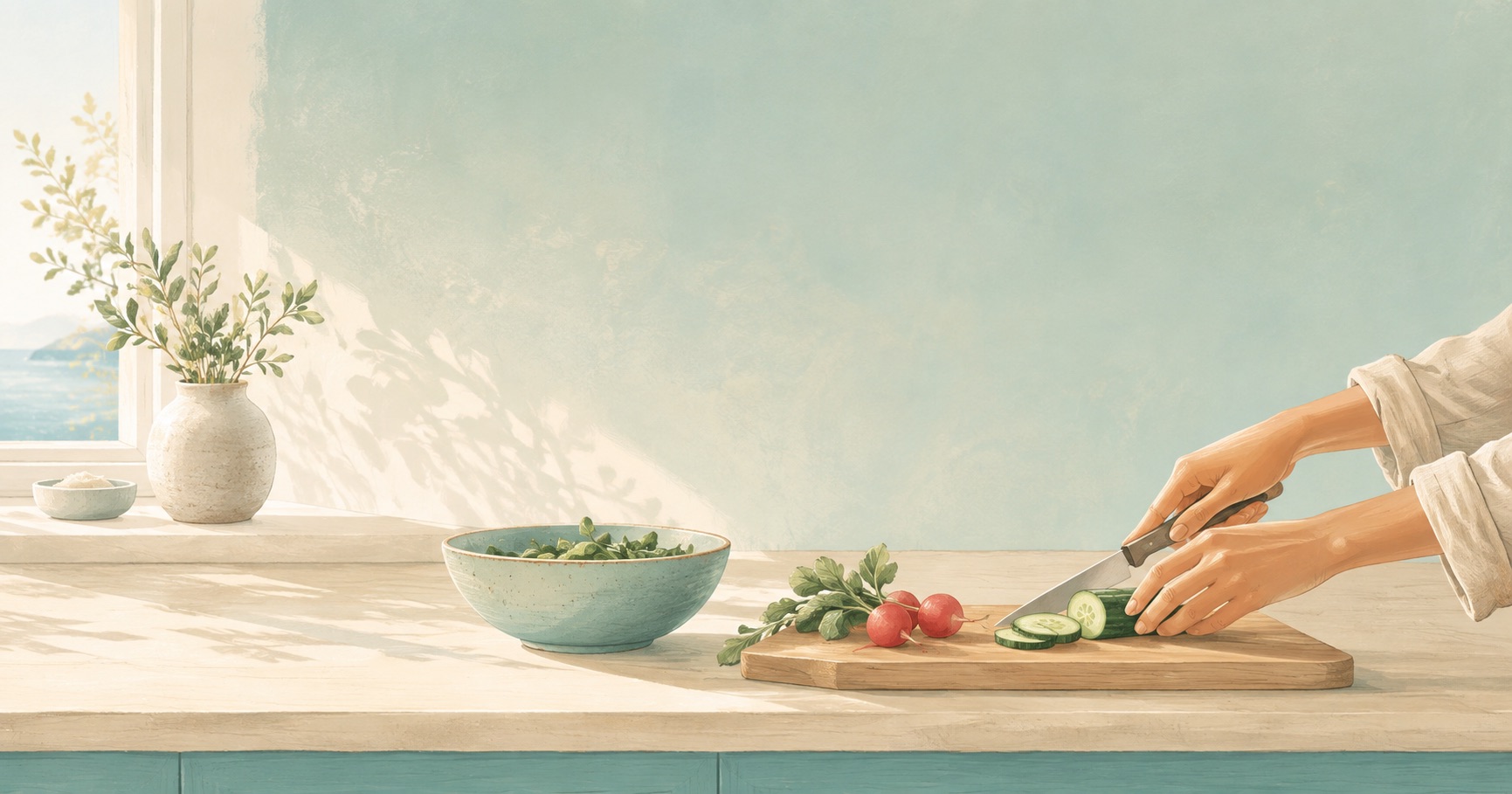
One knitting stitch, one knife stroke, one wiped plate. These repeats are easy, and they ask for a little attention. The little is the point. With attention resting on the hands, worry can't occupy the whole head, and because the work is easy, the head doesn't tire. It's the structure meditation builds around the breath, except a hand's work is easier to hold onto than breathing.
Surveys of people who knit find many reporting calm and lighter worry while the needles move, and experiments link regular hand motion with lower stress responses. Read it not as a miracle but as confirmation of something old: busy hands, quiet head.
Plenty of workdays end with nothing to show. Emails sent, meetings held, and nothing remains. Handwork differs. Thirty minutes later the scarf has new rows, the dishes are drying, the drawer is ordered. Having done something gets confirmed by the eyes.
| What the hands do | Attention needed | What remains | The head's state |
|---|---|---|---|
| Scrolling | Almost none | Nothing | New stimulation, nonstop |
| Knitting | A little | Grown rows | Held in one place, quiet |
| Cooking | Moderate | A meal | Following the sequence, settling |
| Tidying, cleaning | A little | A clean space | The space and the head clear together |
| Writing by hand | A little | A written page | Thought slows to the hand's speed |
The first row runs opposite to all the rest. The phone uses the hands, but the attention cost is near zero and nothing remains. Hands busy, head still fed. That's why hard days got harder when I scrolled through them.
With a young kid, solo knitting time doesn't exist, so I hunted for handwork we could share. Making dumplings together, folding laundry, sorting beans. For the kid it's play; for me it's handwork. The kid's hands are slow and the results come out crooked, and the actual result was this: for that stretch, neither of us was on a phone.
Not all handwork qualifies. Attach a must-do-it-well to it and handwork turns back into work. Not grading the results is the condition that keeps handwork restful.
Time when the hands are busy is time the phone stays shut. Start a dive in Sumbi as the cooking or knitting begins and lay the phone face down, and when the handwork ends and the dive finishes, a shell opens and a sea creature joins your sea. Next to the thing your hands made, one creature remains alongside it.
Build your own sea →No tools, no setup. Attend to the water's temperature, the bowl's weight, the suds thinning, and go slow. Rushed, it's a chore. Slowed, it's handwork. This one became my most frequent.
Not the whole house. One drawer. Everything out, wiped, back in: fifteen minutes. Afterward, every opening shows the order, so the reward keeps paying. I started with the living room drawer the phone sleeps in, and putting the phone away got pleasant.
Three lines about the day, on paper. Handwriting slows thought to the hand's speed, and the slowing is the sorting. The trick is writing plainly instead of well.
Cooking has a sequence for the head to follow, and the reward gets eaten. For handwork, a familiar dish done slowly beats a new recipe. Opening the phone for a recipe brings the other apps along, so cook what you know.
Watering, pulling dry leaves, turning the pot. Five minutes, and something visibly different every day. Hand the watering to your kid and it becomes their handwork too.
One line from a phone-down day. On a hard day I washed dishes instead of scrolling. The dishes dried, and something in me dried out a little too. Work the hands do leaves something behind, and that's the good of it.
This article is general information, not medical advice. If sleep or daily life stays disrupted, talk to a professional.
Scan the QR with your phone to open the install page.
 Sumbi
Sumbi