Read enough about the haenyeo, Jeju's free-diving sea women, and wanting to meet the culture in person follows naturally: to enter the water, to taste what the divers brought up. There are several ways in, and every one of them starts from the same fact. A haenyeo is not an attraction. She is a person at work.
The ways to meet haenyeo culture divide into diving experiences run by village cooperatives (a wetsuit and shallow water, alongside working divers), the cooperative-run haenyeo-jip eateries serving the day's catch, Haenyeo's Kitchen, which pairs a performance with a meal, and the guided walks run by the Haenyeo Museum. The experiences mostly require booking and shift with the season and the tide, and whichever way is chosen, two things stay forbidden: approaching divers at work, and harvesting anything in a village fishing ground.
| Kind | What it is | Run by | Booking |
|---|---|---|---|
| Cooperative diving experience | A rubber wetsuit and a guided taste of muljil in shallow water, beside working divers | Village cooperatives, mostly in summer | Book ahead; canceled by tide and weather |
| Haenyeo-jip | Eateries serving dishes made from what the divers harvested | Village cooperatives | Mostly walk-in |
| Haenyeo's Kitchen | A performance about the divers' lives, followed by a meal they prepare | Private venue, begun in Jongdal-ri, Gujwa-eup | Booking required |
| Museum guided walks | A guided walk on the coastal trail from the Haenyeo Museum | The museum, on an occasional schedule | Announced on the museum website |
| Haenyeo festival | The divers' songs, diving demonstrations, hands-on booths | Jeju Province, in autumn | Check the event notices |
Which villages run experiences, and on what terms, changes every year. The Jeju Tourism Organization's site and each cooperative's own notices are the sources to check.
In summer, cooperatives in a number of shore villages run diving experiences. Participants borrow a wetsuit, goggles, and a tewak float, enter shallow water beside working haenyeo, learn the diving posture and how to settle the breath, and try spotting a conch or a sea urchin. What is found is usually eaten on the spot or handled by the cooperative's rules; whether anything may be taken home differs by village.
The sea decides everything. High waves or a wrong tide cancel the session, sometimes on the day itself. Swimming ability is not strictly required, since the water is shallow and a diver stays alongside, but health conditions must be declared in advance, and many villages set a minimum age for children.
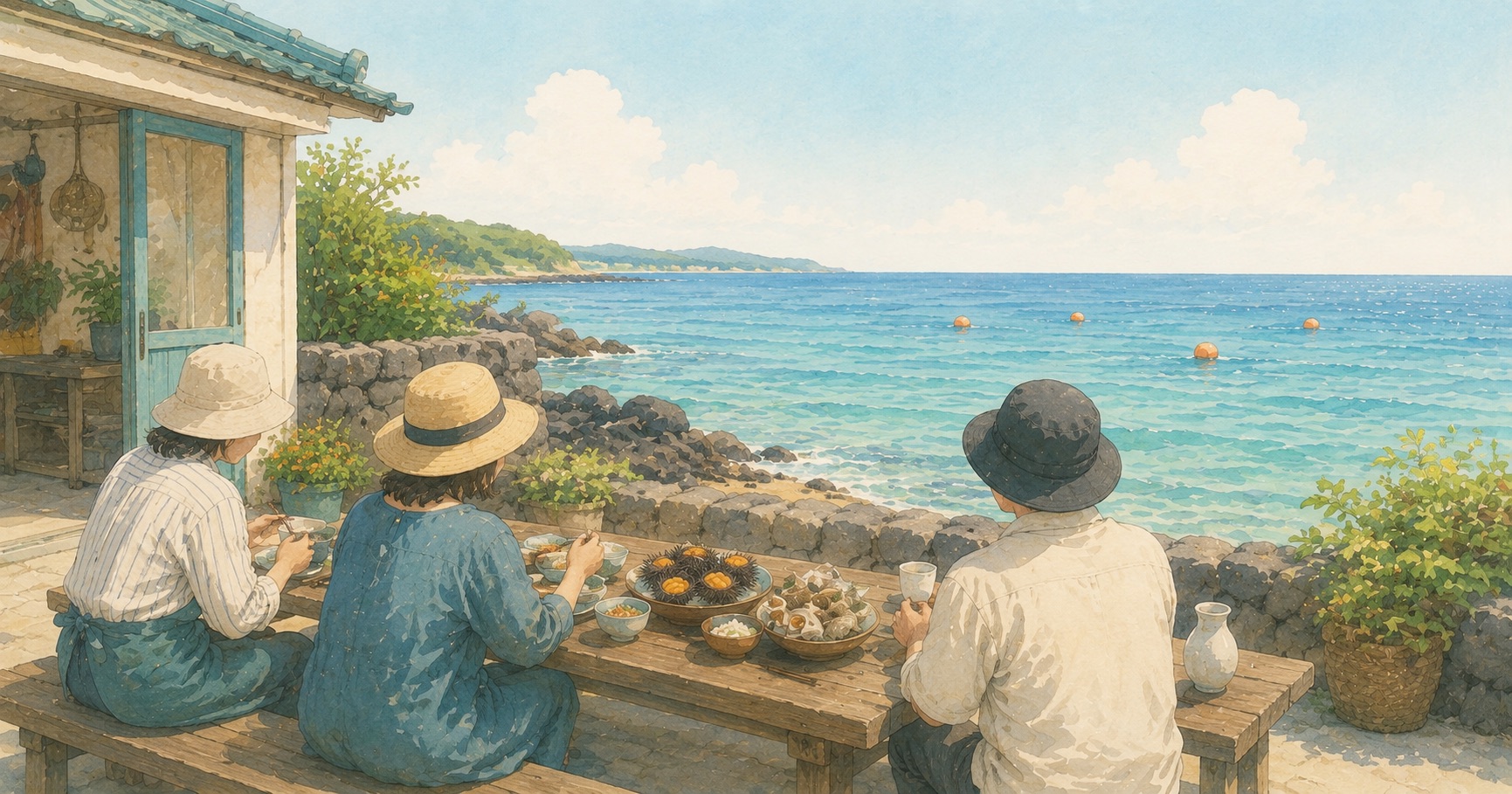
A haenyeo-jip is an eatery run directly by a village cooperative. The conch, sea urchin, and abalone the divers brought up that day become dishes such as mulhoe, a cold raw seafood soup, sea urchin noodles, and abalone porridge. Nothing about it is fancy, and that is the point: the people who harvested it are the people selling it, and the proceeds return to the cooperative. They stand in shore villages across the island, not always under the haenyeo-jip name.
Haenyeo's Kitchen is a private venue that began in Jongdal-ri, Gujwa-eup: a staged performance about the divers' lives, followed by a meal the divers prepare. It was founded by a haenyeo's daughter, the village's divers appear in it themselves, and its stated aim is to raise the standing of Jeju catches such as the horned turban conch. It runs on fixed sessions, booking required.
What the two share is that the divers' side sells what the divers harvested. With no middleman, the price returns to the haenyeo, and only what came out of the sea that day reaches the table. It is why the easiest way to support the culture is, quite literally, to eat there.
The etiquette of meeting a haenyeo is distance: stay out of the water she is working, and watch from far off. Sumbi keeps the same distance with its users, never grabbing or watching over anyone, only waiting alongside through the time they chose. Sumbi supports the documentation and preservation of Jeju haenyeo culture.
See the ocean Sumbi made →A diver in the water is a person on the job. Watching from the shore at a distance is fine; swimming toward her, steering a boat near, or calling out is dangerous as well as rude. Photographing around the changing rooms is also best left undone.
The conch, abalone, sea urchin, and seaweed of a village fishing ground belong to the cooperative, and harvesting by non-members is prohibited by law. Picking up a few shells at the waterline counts. The one exception is inside an experience program, under a diver's guidance.
Posting unpermitted photos of a diver's face as she comes out of the water has become common. A haenyeo is not a public figure; she is a person at work. The rule is simple: ask first, and if she declines, put the camera away.
One line the sea taught us. The best way to meet the haenyeo is to keep the distance they set. Putting the phone down begins the same way, with a distance set between the phone and yourself.
This article is a cultural introduction based on published sources; figures reflect the survey dates listed in the references.
Scan the QR with your phone to open the install page.
 Sumbi
Sumbi