What is in a haenyeo's mangsari net is decided by the calendar. Brown seaweed in spring, sea urchin in early summer, conch in winter. And between the seasons run stretches when nothing is taken at all. The work of Jeju's free-diving sea women only comes into view when the harvesting and the not-harvesting are looked at together.
Haenyeo mainly harvest conch, abalone, sea urchin, sea cucumber, and octopus, plus seaweeds such as miyeok, agar weed, and tot. Conch peaks from winter into spring, the seaweeds in spring, sea urchin in early summer, abalone and sea cucumber from autumn into winter. Law sets closed seasons (summer for conch, the autumn spawning season for abalone) and size limits (no conch under 7 cm shell height, no abalone under 10 cm shell length), and each village cooperative adds its own rules on top, such as the seaweed opening day and the daily entry hours. The periods and numbers change by statute and notice, so the source documents in the references are the ones to check.
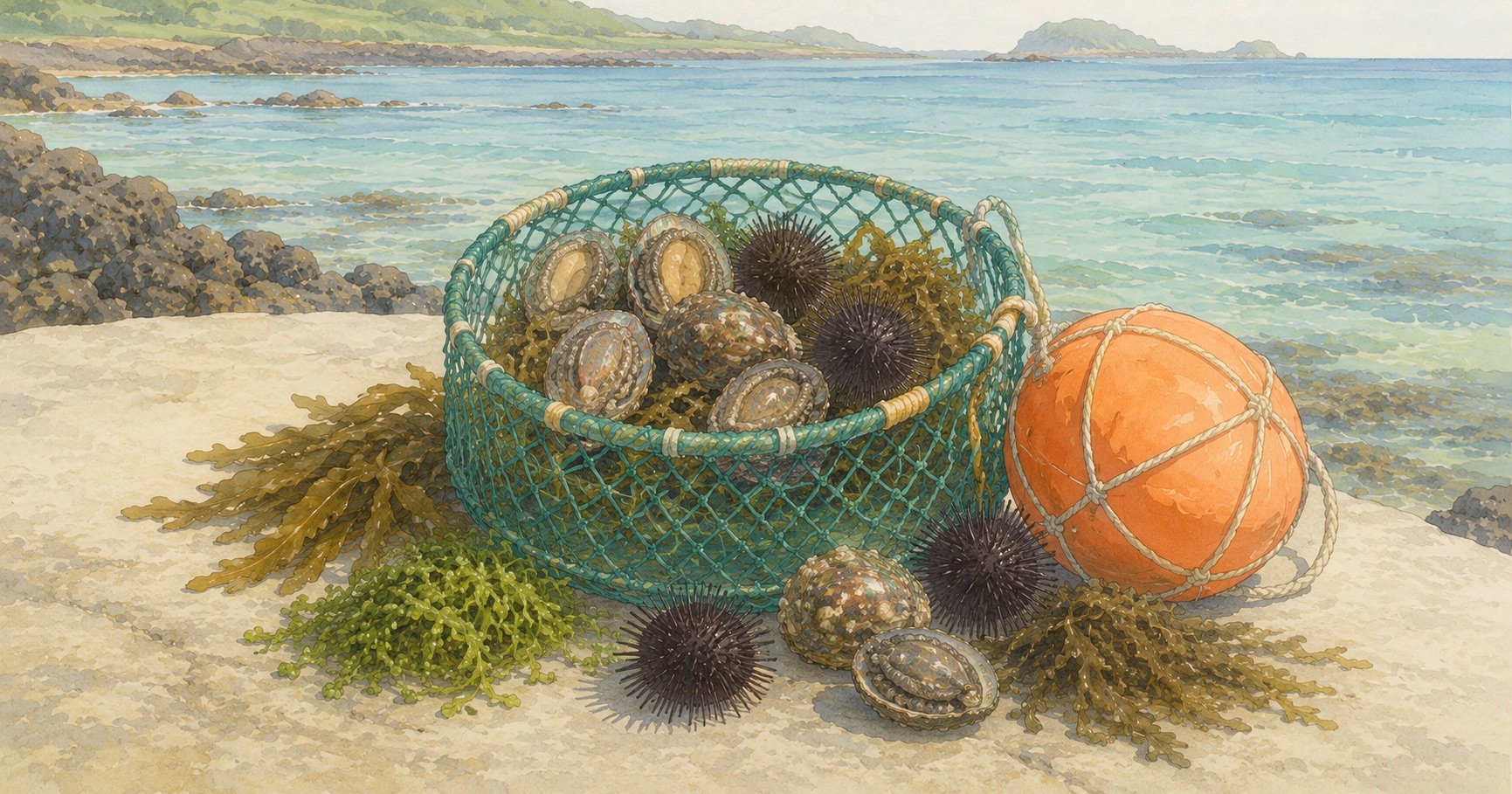
The catch from Jeju's waters falls into shellfish, echinoderms, and seaweeds. The high prices belong to abalone, conch, and sea cucumber; the high volumes to the seaweeds, miyeok, agar weed, and tot. A haenyeo's year turns on the meshing of these seasons with the closed periods between them.
| Catch | Season | Main rules | Notes |
|---|---|---|---|
| Conch | Winter to spring | Closed in the summer spawning season; none taken under 7 cm shell height | A large share of diver income |
| Abalone | Autumn to winter | Closed in the autumn spawning season; none taken under 10 cm shell length | The sanggun's catch, pried with the bitchang blade |
| Sea urchin | Late spring to early summer | Harvest window set by each cooperative | Cleaning the roe takes longer than the diving |
| Sea cucumber | Winter to spring | Closed in summer, its dormant season | Vanishes as the water warms |
| Octopus | Winter to spring | Rules set by each cooperative | Pulled from crevices with the kkakkuri hook |
| Miyeok (brown seaweed) | Spring | Opening day (haegyeong) declared by the cooperative | Harvested by the whole village together |
| Agar weed | Spring to early summer | Window set by the cooperative | Dried before sale |
| Tot (hijiki) | Spring | Window set by the cooperative | Harvested by the whole village together |
The table shows the general pattern. The exact dates and numbers of the closed seasons and size limits are set by the Fishery Resources Management Act, its enforcement decree, and provincial notices, and they can change from year to year.
A closed season halts the harvest through spawning so that a next generation is left behind. Conch spawn in summer and abalone in autumn, so in those months no hand touches them. The size limits protect the young that have not yet spawned: a conch under 7 cm of shell height or an abalone under 10 cm of shell length stays on its rock. A haenyeo sizes the shell by eye, underwater, mid-breath, and if it is small she does not touch it.
These rules existed in the community before the law wrote them down. Leaving the young conch and abalone was the custom first; the statute later fixed the custom in numbers. It is the same practice UNESCO singled out as a sustainable way of harvesting.
Above the law sit the village's own rules. The best known is the haegyeong, the seaweed opening day. Cutting miyeok is banned while it grows, and then, on a day the cooperative declares, the whole village harvests at once. Cutting before the haegyeong is counted a serious wrong within the village.
Some of these rules are written down; others hold as pure custom. They differ from cooperative to cooperative and change by agreement of the haenyeo association.
A haenyeo's year holds seasons for harvesting and seasons for leaving the sea alone, and that rhythm of rest is what has let the work continue for centuries. A Sumbi dive follows the same shape: not the whole day but a chosen stretch of it, because the pause is what makes the next dive possible. Sumbi supports the documentation and preservation of Jeju haenyeo culture.
Meet Sumbi →Nothing a haenyeo brings up is sold on her own account. The catch moves through the village cooperative to the fisheries co-op, or through village-run outlets such as the haenyeo-jip eateries, and volumes and income are recorded and managed at the community level.
With sea urchin, opening the shells takes longer than gathering them. Divers seated in a ring outside the changing rooms, cracking urchins through the afternoon, are an early-summer fixture of the Jeju coast. The seaweeds sell dried, so they wait on days of good sun.
The surest way to eat the haenyeo's catch in season is a village-run haenyeo-jip: miyeok soup and sea urchin noodles in spring, conch and abalone in winter. Gathering anything from the shore in person is prohibited by law.
One line the sea taught us. A haenyeo leaves the small ones and keeps her hands still through the spawning season. Time away from the phone begins the same way, not by cutting everything off, but by setting aside hours of the day that stay untouched.
This article is a cultural introduction based on published sources; figures reflect the survey dates listed in the references.
Scan the QR with your phone to open the install page.
 Sumbi
Sumbi