Read enough about the haenyeo and one place starts pulling: the Haenyeo Museum in Hado-ri, Gujwa-eup. It stands in one of the villages with the most working divers, holding their recorded voices, their tools, and their clothes. Here is how to see it well, laid out as a simple guide.
The Haenyeo Museum is Jeju's public museum devoted to haenyeo culture, in Hado-ri, Gujwa-eup, with halls on the haenyeo's life, work, and community plus outdoor exhibits. The exhibits alone take about an hour; with the films and recorded oral histories, closer to two. The memorial tower to the haenyeo resistance movement stands beside it, a 4.4 km coastal loop trail begins at the museum, and Sehwa Beach is within walking distance. Hours, closing days, and fees change, so the museum's website is the source to check.
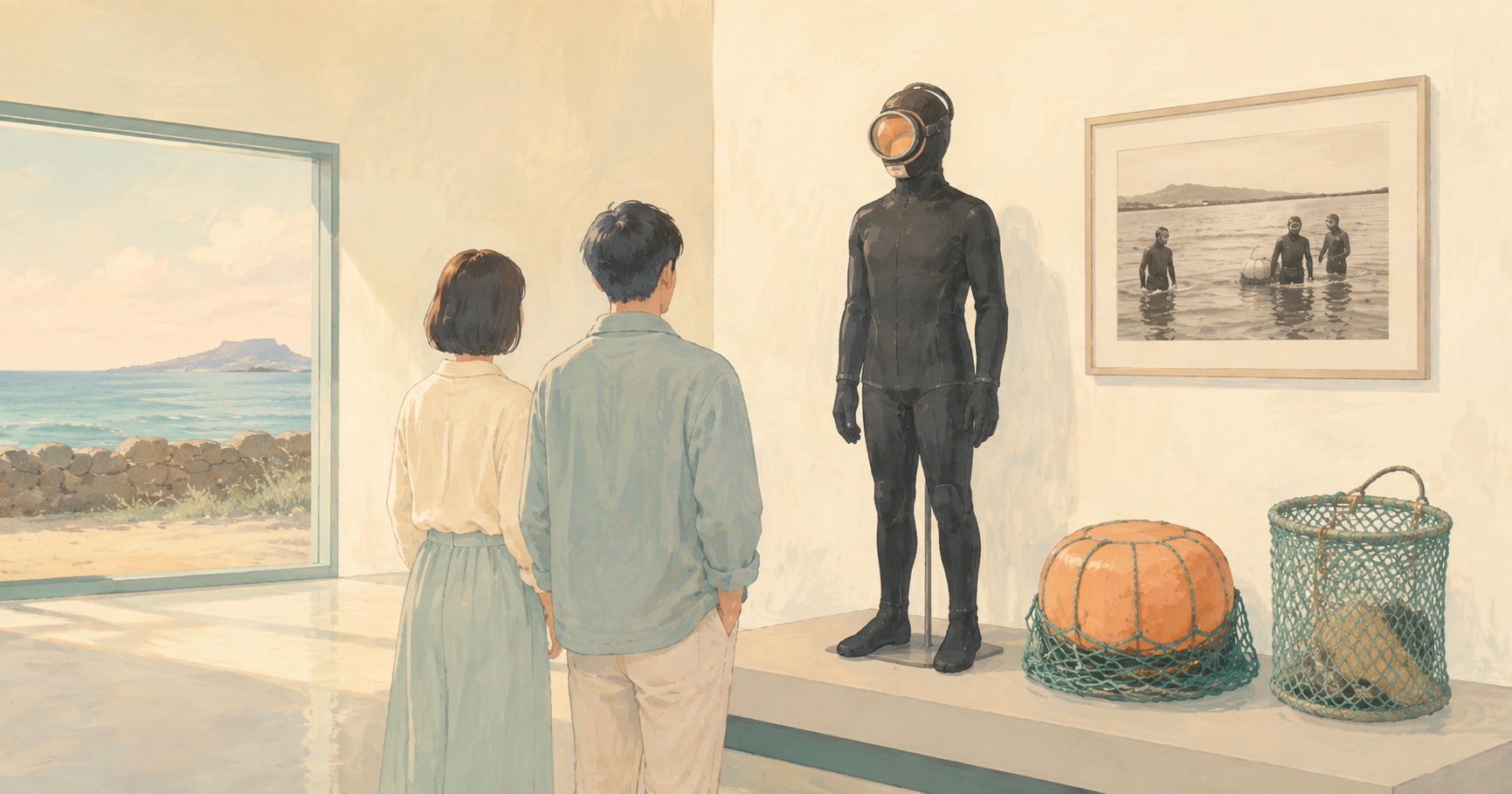
The museum is a public institution run by Jeju Province, devoted entirely to haenyeo culture. Hado-ri is among the villages with the most working divers, and it is where the haenyeo resistance movement of the colonial era began, which is why the museum stands here. Beyond the exhibits, it has long run an oral history archive, recording the lives of elderly divers in video and sound, and that archive underpins both the displays and the research.
| Space | What it holds | Not to miss |
|---|---|---|
| Hall 1, the haenyeo's life | Diving tools, the changing suits, a diver's lifetime | The recorded voices of real divers linked to each tool |
| Hall 2, the haenyeo's culture | The community around the bulteok, the jamsugut rite, the songs | The recreated bulteok |
| Hall 3, the haenyeo's story | Individual lives and records, the children's exhibit | The worn, hand-used belongings of divers |
| Outdoors | The haenyeo statue, the resistance movement memorial tower | The inscription at the foot of the tower |
| Screening room | Documentaries on the haenyeo | Worth catching from the start if the timing works |
Hall names and layouts can change with renovations. The table follows the published guide, and the museum's website is the authority for current details.
Taken in order, Hall 1 teaches the work through the tools and the clothes, Hall 2 shows the community wrapped around that work, and Hall 3 narrows to a single life. The route runs from the large to the small. Short on time, the recorded voices in Hall 1 and the recreated bulteok in Hall 2 carry the heart of it.
One thing changes how the whole museum reads. Most of what it holds was given by the divers themselves: the tewak floats and bitchang blades they used, the cotton mulsojungi they wore, and their own voices telling their own lives. These are donations rather than artifacts, records rather than displays.
With children, Hall 3 has a children's exhibit, and the haenyeo statue outside is the photo spot. Afterward, the walk to Sehwa Beach ends in clear water, cafes, and a bookshop or two.
From Jeju City, the coastal road east toward Gujwa-eup passes Sehwa-ri and reaches the museum at the mouth of Hado-ri. The east coastal bus route from the Jeju City bus terminal stops right outside at the Haenyeo Museum stop, and there is a parking lot.
The Haenyeo Museum is where the vanishing voices and sounds of this culture have been collected, the very documentation and preservation Sumbi cheers for. The app's name and rules come from the stories this museum keeps. Sumbi supports the documentation and preservation of Jeju haenyeo culture.
Meet Sumbi →The voices and films in the halls are real divers telling their own lives. The considerate way is to let each recording play out, and to leave the flash off even where photography is allowed. The posted signs settle any doubt.
Hours, closing days, and fees change. As a public museum it closes Mondays and major holidays, so a call or a look at the website before visiting is worth it. This guide deliberately lists no operating details.
The museum runs occasional guided walks along the coastal trail. A guide walks the route telling the stories of the bulteok and the haesindang shrine, and on a lucky day working divers can be seen far off the shore. Announcements go up on the website.
One line the sea taught us. What the museum works to keep is not the divers' tools but the way the divers treated the sea. Putting the phone down begins in the same place: less in changing the tool than in changing how it is treated.
This article is a cultural introduction based on published sources; figures reflect the survey dates listed in the references.
Scan the QR with your phone to open the install page.
 Sumbi
Sumbi