More people want to become haenyeo: people who left city jobs for Jeju, people drawn simply by the sea. Where the door to that life stands, how it opens, and what waits on the far side of it, laid out from the publicly available materials.
Jeju's haenyeo schools are the Hansupul school in Hallim-eup, run by Jeju City, and the Beophwan school in Seogwipo, run by Seogwipo City. Hansupul offers a professional course and an introductory course, running from May to late August, and the professional course requires a recommendation letter from a village cooperative. Beophwan runs a professional course of around seven weeks for women under 55. Graduation alone makes no one a haenyeo: a graduate must still pass the cooperative's review and be admitted as a member, and roughly three in ten graduates make it that far.
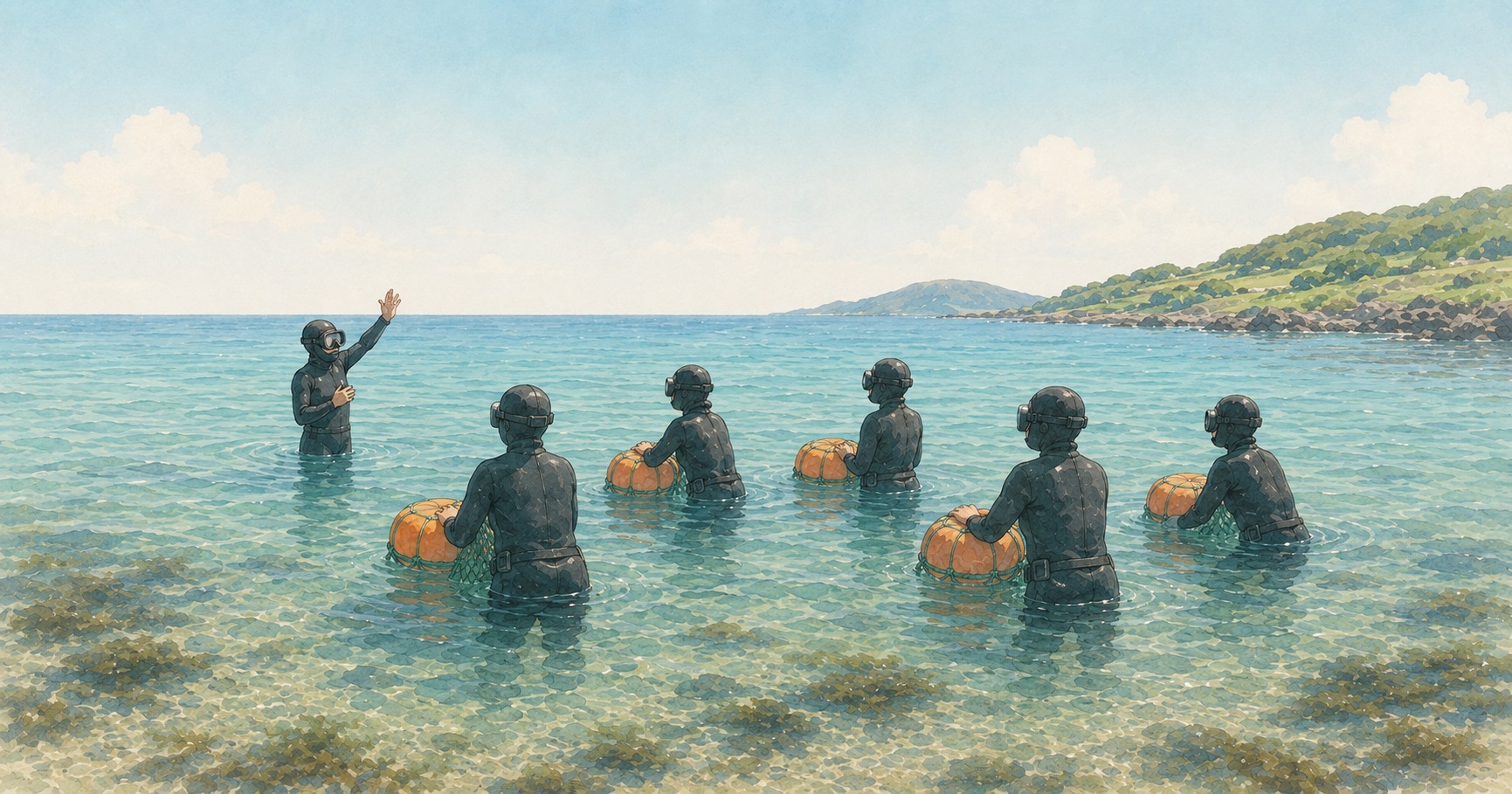
The two schools differ in who runs them and what they offer. The Hansupul school stands in Gwideok-ri, Hallim-eup, and is run by Jeju City. Opened in 2008 as the first of its kind, it pairs a professional course for people who mean to dive for a living with an introductory course for people who want to learn the culture in the body. The Beophwan school, in Beophwan-dong, Seogwipo, opened in 2015 and concentrates on training professional divers.
| Hansupul school | Beophwan school | |
|---|---|---|
| Location and operator | Gwideok-ri, Hallim-eup; Jeju City | Beophwan-dong; Seogwipo City |
| Courses | Professional course, introductory course | Professional diver course |
| Training period | Early May to late August, three to four months | Around seven weeks, in spring |
| Eligibility (professional) | Jeju residents under 60, cooperative recommendation required | Women under 55; a recommendation earns extra points |
| Introductory course | Open to applicants from outside Jeju | None |
| Competition | High for the introductory course, lower for the professional | Varies by year |
| Inquiries | Jeju City fisheries department | Beophwan school office |
Class sizes, age limits, and periods change every year. The table follows the published recruitment guides, and the current year's notices from each city and school are the ones that count before applying.
The training splits into theory and water. Theory covers haenyeo culture, the cooperative system, safety, and the management of marine resources; in the water, trainees learn diving posture and breathing in the shallows, how to use the tewak float, and how to take conch and sea urchin. Working sanggun, the top-rank divers, teach.
Graduates say the same thing in almost the same words: far harder than expected. Trainees swallow a great deal of seawater, and more than a few think about quitting in the first week. The course doubles as a lesson, learned in the body, in why so many haenyeo refused to pass the work to their daughters.
No. A haenyeo must be a member of a village cooperative, and admission is decided by the village, not the school. A graduate first works months as a probationary member or intern, then passes the cooperative's review to become a full member. A cooperative shares a finite fishing ground and does not admit new members lightly, and the bar sits higher for anyone without ties to the village.
By the figures the two city governments have released over recent years, roughly three in ten professional-course graduates go on to join a cooperative and actually dive. Of the several hundred who have finished at Beophwan since it opened, on the order of ninety have joined cooperatives. The rest stop at the experience, or turn elsewhere in the face of the admission bar and the thin early income.
The first class at a haenyeo school is not how to go deep but how to settle the breath and come up. A Sumbi dive starts at ten minutes on exactly that principle: not practice at holding out, but practice at surfacing when the time you set arrives. Sumbi supports the documentation and preservation of Jeju haenyeo culture.
Dive the length of one breath →Jeju City subsidizes a new diver's cooperative admission fee up to a set amount and pays younger newcomers a settlement grant across their first years; Seogwipo City runs similar support. Amounts and conditions change annually, so the official notices are the reference.
A new haenyeo starts in shallow water and earns little. Reaching sanggun rank takes years, and through those years diving alone rarely pays for a life, which is why so many divers hold second jobs. Becoming a haenyeo takes more than diving skill; it takes a plan for lasting several lean years.
For anyone who does not mean to dive for a living but wants the culture in the body, the Hansupul introductory course exists, open to applicants from outside Jeju and heavily oversubscribed. Finishing it also earns eligibility to apply for the professional course.
One line the sea taught us. A haenyeo school raises people who surface on time before it raises people who go deep. Practice with a phone counts the same way: not the days of holding out longest, but the days of coming back when the time is up.
This article is a cultural introduction based on published sources; figures reflect the survey dates listed in the references.
Scan the QR with your phone to open the install page.
 Sumbi
Sumbi