There are ranks among the haenyeo, Jeju's free-diving sea women: sanggun, junggun, hagun. The words sound like a hierarchy, and they are, but in practice they mostly describe how far out and how deep each diver may go. And attached to each rank there are more duties than privileges.
Haenyeo are divided into sanggun, junggun, and hagun by diving depth, breath, and harvesting skill. The sanggun, the most capable divers, work the deepest water, decide when a session begins and ends, and lead the younger divers. The junggun work the middle depths, and the hagun build experience in the shallows. No exam confers the rank; it settles naturally among the divers who work together, and when age shortens the breath, a diver moves back to shallow water.
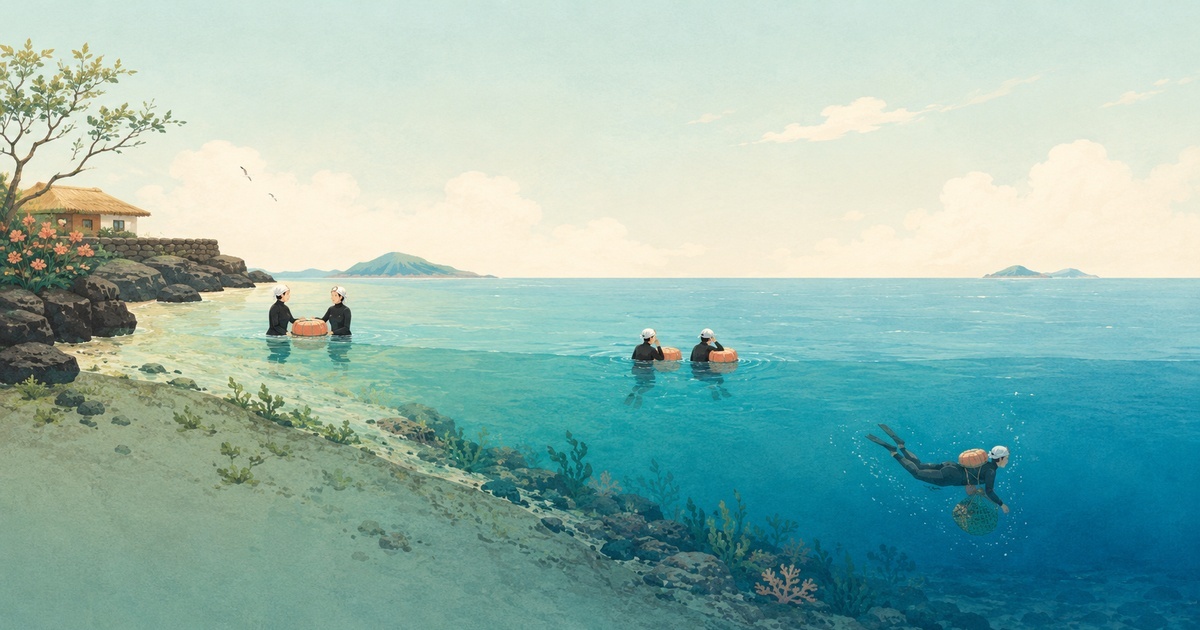
The measure is depth. How deep a diver goes, how long she holds her breath there, and what she brings up decide her rank. A sanggun typically works beyond 10 meters, holding her breath close to two minutes to take large abalone and conch. A hagun makes short dives in water around 5 meters. The junggun sit in between. Some villages add a daesanggun above the sanggun, or an aegi-jamsu, a beginner diver, below the hagun.
There is no formal test. The divers who share the water know one another's skill, because it shows every day: how far out each one goes, what she brings up, how she judges a dangerous morning. Rank is not conferred by anyone. It is recognized within the community.
| Rank | Depth | Main catch | Role |
|---|---|---|---|
| Sanggun | Beyond 10 m, far grounds | Large abalone, conch, sea cucumber | Calls the start and end of a session, teaches, watches for danger |
| Junggun | 5 to 10 m | Conch, sea urchin, abalone | The main harvesting force, supports the sanggun |
| Hagun | Around 5 m, near shore | Sea urchin, agar seaweed, brown seaweed | Learns the craft, works the shallows |
| Halmang (elderly) | Shallow water (halmang-badang) | Conch, seaweeds | Harvests a breath's worth, passes on experience |
Her first duty is judgment. Whether the sea can be entered today, when everyone must come out, which side of the ground is turning dangerous: the sanggun reads it. When the sanggun comes out of the water, the others follow. Calling out a hagun who lingers too long over a good patch is the sanggun's job too.
Her second duty is teaching. How to read the tide, how to find abalone under a rock, how to turn for the surface the moment the breath runs short: none of it is in a book. The sanggun shows, the hagun follows and copies. At the bulteok, the stone windbreak where divers warm up after work, the seat closest to the fire belongs to the sanggun, and it is also the seat that talks the most.
Her third duty is representing the community. In the haenyeo association, the sanggun's word carries the most weight on the decisions that matter: the dates of the closed season, the care of the fishing ground, the vetting of new members.
Rank travels no farther than the village. A sanggun who moves to another village does not know that sea, so she starts from the beginning. Which rock hides abalone and which channel turns deadly differs from shore to shore, and that knowledge passes only inside each village's own haenyeo association.
Becoming a sanggun is usually said to take more than ten years. And every sanggun one day feels her breath shorten and returns to the halmang-badang, the shallows reserved for elderly divers. Rank is not a ladder that only goes up. It rises and falls with the sea and with the body.
A haenyeo works the depth her rank allows and takes only a breath's worth from it. A Sumbi dive grows the same way, starting at ten minutes and lengthening as your own breath does: not deeper than the next person, just a little deeper than yesterday. Sumbi supports the documentation and preservation of Jeju haenyeo culture.
See the ocean Sumbi made →When the divers gathered at the bulteok after a session, the seating had an order. The warm seats by the fire went to the sanggun, then the junggun, with the hagun on the outside. It was a hierarchy, but it was also a seating chart for learning: the hagun learned the sea by listening to the sanggun talk.
The deep water belongs to the sanggun; the shallows belong to the hagun and the elderly. If the strongest divers swept the shallow ground too, nothing would remain for the weakest, so rank doubles as the rule for dividing the sea. Halmang-badang is the clearest expression of it.
As the working population ages, the sanggun are thinning fastest. Some villages are down to one or two, or none. Without a sanggun, the deep grounds go unharvested and the hagun have no one to learn from. When the rank system wavers, it is a signal that the culture underneath it is wavering.
One line the sea taught us. The sanggun is not the diver who goes deepest but the one who knows best when to come out. Practicing with a phone runs the same way: the person who surfaces on time lasts longer than the person who holds out longest.
This article is a cultural introduction based on published sources; figures reflect the survey dates listed in the references.
Scan the QR with your phone to open the install page.
 Sumbi
Sumbi