That UNESCO wrote the Jeju haenyeo into the heritage of humanity is widely known. What exactly was recognized is not. Was it the diving technique? The profession itself? The inscription documents answer the question themselves, and this article follows what they actually say about Jeju's free-diving sea women.
UNESCO inscribed the Culture of Jeju Haenyeo on the Representative List of the Intangible Cultural Heritage of Humanity in 2016, recognizing the diving skill together with community solidarity, the social role of women, and a sustainable, nature-respecting way of harvesting. The designation of haenyeo as national intangible heritage followed in 2017, and in 2023 the FAO listed Jeju haenyeo fisheries as a globally important agricultural heritage system. In all three recognitions, the heart of the matter was not technique but a culture and a way of working.
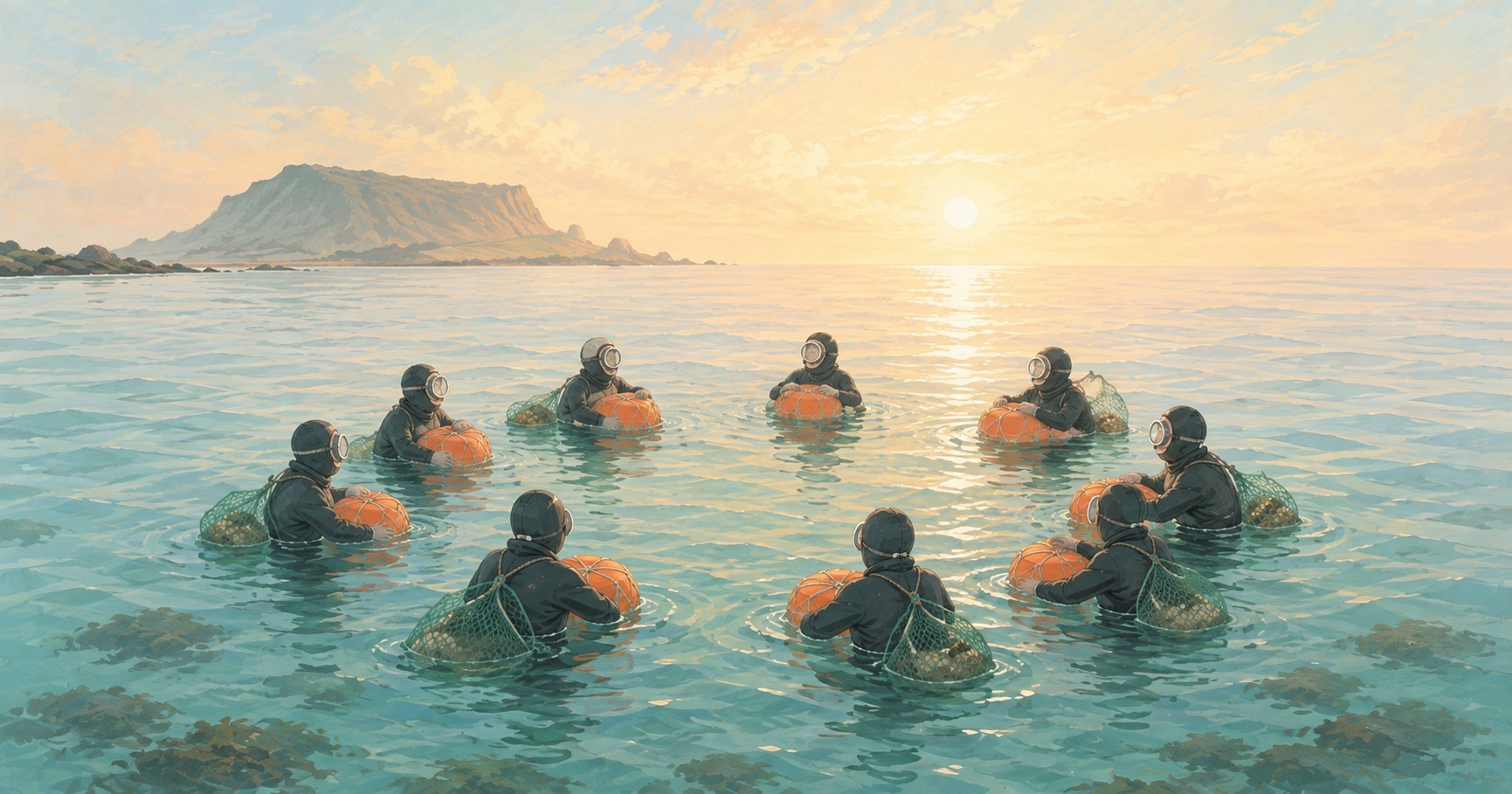
The inscribed name is not haenyeo but the Culture of Jeju Haenyeo. The entry on UNESCO's Representative List describes, as one whole, the skill of harvesting seafood by diving without oxygen equipment, the way diving technique and knowledge of the sea pass from generation to generation, and the community life carried by haenyeo associations, by the jamsugut ritual, and by the songs. The subject is not the divers alone but the entire culture they built.
The decision came on November 30, 2016, at the eleventh session of the Intergovernmental Committee for the Safeguarding of the Intangible Cultural Heritage, held in Addis Ababa, Ethiopia. It became the nineteenth element inscribed for the Republic of Korea.
| Recognized value | The gist of UNESCO's account | What it looks like in practice |
|---|---|---|
| Community identity | Solidarity and transmission through haenyeo associations | The eochongye and haenyeo-hoe, and knowledge passed on at the bulteok |
| The role of women | Fishing and household economies led by women | Generations of families supported on diving income |
| Coexistence with nature | Environmentally friendly, sustainable harvesting | Closed seasons, size limits, halmang-badang, and leaving the young shellfish |
First, community. A haenyeo does not dive alone. Every village crew forms a haenyeo association that watches over safety, sets the rules of the fishing ground together, and gathers after muljil at the bulteok, the stone windbreak where knowledge changes hands. UNESCO saw in that organization the force that keeps the culture alive.
Second, the role of women. Diving income fed families and paid for children's educations, a rare case of women standing at the center of a household economy. The committee weighed it as a key to the standing and identity of Jeju women.
Third, coexistence with nature. Haenyeo leave young conch and abalone in the water, stop harvesting entirely during set periods, and yield the shallow grounds to their eldest members under the custom of halmang-badang. Diving on one breath is itself a brake on overharvesting: nobody can take more than a breath allows. UNESCO read the whole arrangement as a model of sustainability.
Three institutions applied three different standards, but the recognitions share one thread: each looked not at how much the divers harvest, but at how they manage to harvest for so long.
The way of working UNESCO singled out is a practiced restraint: take only a breath's worth, leave the young shellfish, yield the calm shallows to the old. Sumbi is an attempt to carry that restraint into life with a phone, one chosen dive at a time. Sumbi supports the documentation and preservation of Jeju haenyeo culture.
Meet Sumbi →Jeju operates support programs grounded in its ordinance on preserving and transmitting haenyeo culture: medical cost support and wetsuit subsidies for divers, the haenyeo schools, and settlement support for new entrants. The Haenyeo Museum continues to record oral histories and collect material. The inscription became the anchor for these policies.
Interest at home and abroad grew after the listing. Documentaries and dramas took up the haenyeo, and visitors to diving experiences and to the village-run haenyeo-jip eateries increased. The attention brought problems of its own, with tourists disturbing divers at work or wandering into fishing grounds, and viewing etiquette has become a standing task.
The inscription did not stop the decline in numbers. Most working haenyeo are elderly, and new entrants are few. Who will carry a culture the world has recognized is the largest question the inscription left open.
One line the sea taught us. What the world saw in the haenyeo was not a better way to harvest but a practiced way to stop. With a phone, too, deciding when to surface comes before finding out how long you can hold on.
This article is a cultural introduction based on published sources; figures reflect the survey dates listed in the references.
Scan the QR with your phone to open the install page.
 Sumbi
Sumbi