In every haenyeo community there is a stretch of sea that most divers never enter: the shallow water worked only by the divers whose breath has grown short with age. It is called halmang-badang, and nearly the whole rulebook of haenyeo culture fits inside this one small patch of sea.
Halmang-badang is the custom of setting aside the shallow, near-shore section of a village fishing ground as the share of the community's elderly divers. Younger haenyeo do not enter that water, and the older divers harvest there a breath's worth at a time. No law enforces it; it holds by the agreement of the village cooperative, and it is cited as the signature example of the community spirit named in the UNESCO inscription.
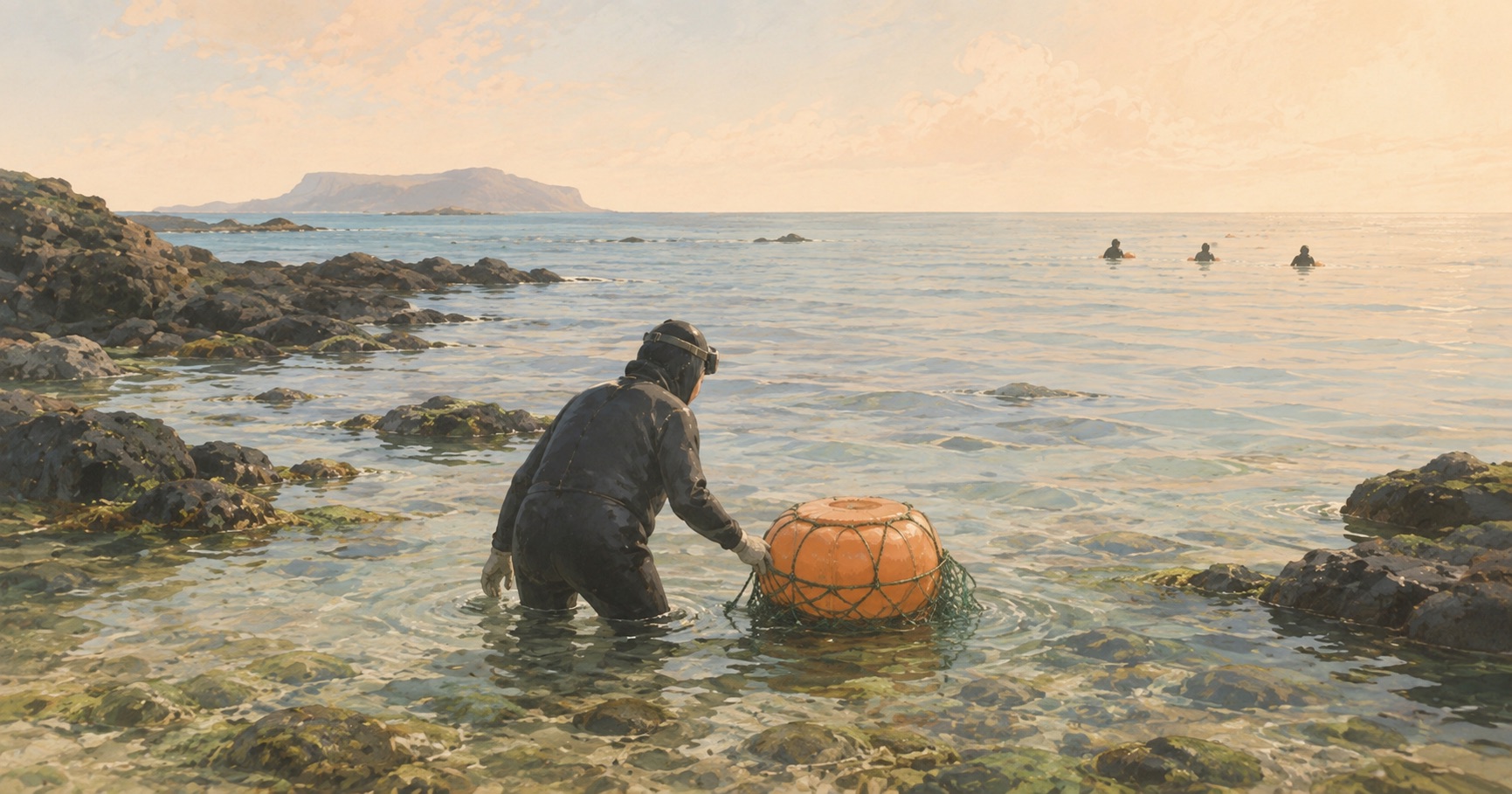
In the Jeju language, halmang is grandmother and badang is sea. Every village has its assigned fishing ground, and within it the section closest to shore, shallow enough that no long breath is needed, is held as halmang-badang. Which water it is, and how far it runs, is decided by the village cooperative, and the name and boundaries differ a little from village to village.
| Halmang-badang | The rest of the ground | |
|---|---|---|
| Location | Close to shore and shallow | The whole village fishing ground |
| Who enters | Elderly divers and divers in poor health | Every haenyeo in the cooperative |
| Who decides | The cooperative's agreement | Cooperative rules and the fisheries co-op |
| Purpose | Diving that continues without retirement | Livelihood |
What matters is that no document enforces the custom. A young diver who took conch from the halmang-badang would break no statute. Inside the community, though, it is simply a thing that is not done.
A haenyeo earns what she brings up that day. Anyone can take the conch of the shallows, so if the young entered first, nothing would remain for the old. Halmang-badang cuts that competition off before it starts: the sanggun, the strongest divers, head for the deep, and the near water is left alone.
The yielding is not one-directional. The diver who is a sanggun today will feel her own breath shorten one day, and if there is to be a sea waiting for her then, it has to be left alone now. Halmang-badang is less an act of kindness than a rule that keeps the community running across generations.
When the Culture of Jeju Haenyeo entered UNESCO's list of intangible heritage, the inscription named the community's durability alongside coexistence with nature and the role of women. Halmang-badang is the example cited most often to explain that community spirit, together with the rule of leaving young conch and abalone and the closed seasons: all of them ways a community sets its own limits so that both the sea and its people last.
What makes halmang-badang remarkable is not only that it protects the weakest. It is the form the protection takes: not money, not help, but a place. An elderly diver lives on no one's charity; she harvests with her own hands, in her own water. It is consideration built to preserve dignity.
The details of halmang-badang differ by village, and this account is a general one drawn from the public materials of the Haenyeo Museum and the Jeju provincial government.
The name Sumbi comes from the sumbisori, the long whistling breath a haenyeo lets out at the surface, and the app's dives from her way of staying only a breath's worth. The rule that sends creatures back to the open sea when an ocean grows full carries the spirit of halmang-badang: enough is kept, the rest is left for others. Sumbi supports the documentation and preservation of Jeju haenyeo culture.
Begin your first dive →With most working haenyeo now in their seventies or older, the number of divers bound for the halmang-badang grows while the sanggun who work the deep grow scarce. In some villages, most of the ground is now used, in practice, the way halmang-badang always was. The rule is unchanged; the mix of people sharing it has turned over.
A newcomer who reaches a cooperative through haenyeo school learns this boundary along with the diving itself. Which side of which rock is halmang-badang appears on no map; it passes by word from the seniors she works beside. Being unwritten, it is also among the easiest parts of the culture to lose.
The Haenyeo Museum has been recording the oral histories of elderly divers in video and sound. Rules like halmang-badang, carried by speech rather than paper, vanish with their villages unless someone records them. Supporting the culture means, in the end, supporting exactly this work of writing it down.
One line the sea taught us. A haenyeo stays in the sea a breath's worth and leaves the rest of the water as someone else's share. Time away from the phone can be measured just as gently: today, one breath's worth, and enough.
This article is a cultural introduction based on published sources; figures reflect the survey dates listed in the references.
Scan the QR with your phone to open the install page.
 Sumbi
Sumbi