Diving for a living is old work on Jeju, but how old is hard to say with precision. The written record begins in the Joseon era; everything earlier is inference. This article follows what the records actually show, tracing how the haenyeo, Jeju's traditional free-diving sea women, passed through each era to reach the present.
Records of Jeju's diving women appear clearly in seventeenth-century Joseon documents under the name jamnyeo, and breath-hold harvesting is presumed to be older still. In the late Joseon period the divers carried the burden of the abalone tribute. From the late nineteenth century came chulga muljil, seasonal migrations that took them to the mainland and as far as Japan. The arrival of the rubber wetsuit in the late twentieth century transformed the work, and today the profession is at once a recognized world heritage and a vanishing trade.
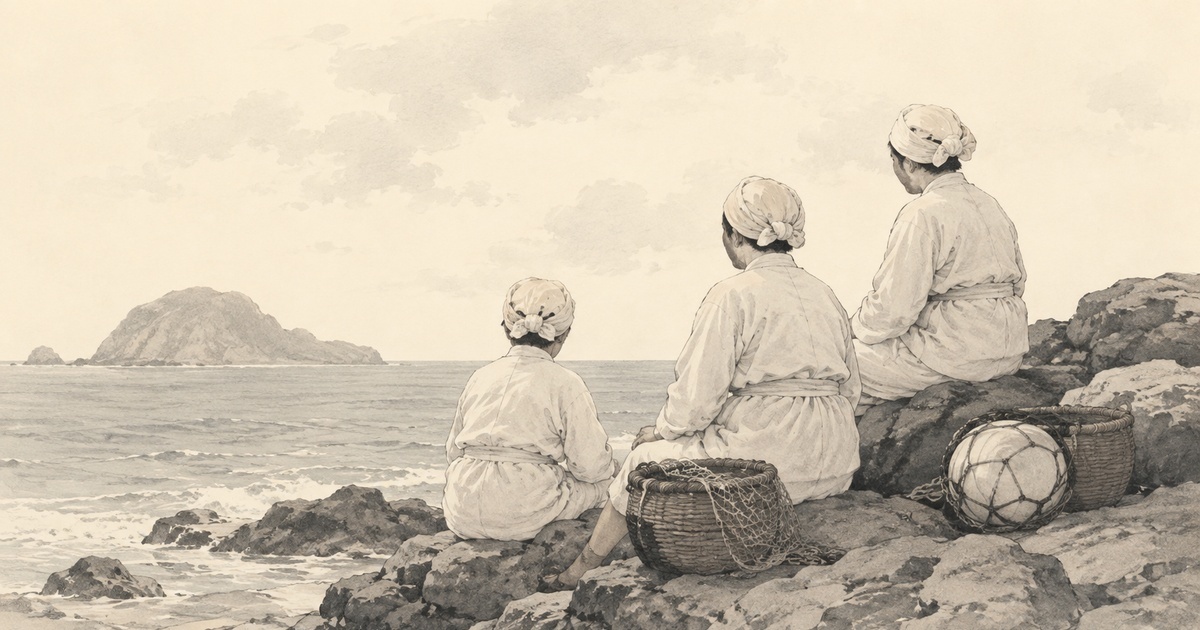
That Jeju women went into the sea to harvest is confirmed in Joseon-era writing. Records left by officials who served on Jeju in the early seventeenth century use the word jamnyeo, describing women who gathered seaweed and abalone and describing how punishing the work was. Literati exiled to the island wrote about jamnyeo as well. Together these records show that by that time the divers already existed as a distinct working group.
Anything earlier is inference. Ancient records note that Jeju sent pearls and abalone as tribute, which suggests breath-hold harvesting reaches far back, but they do not say whether the divers were women. The Haenyeo Museum and much of the scholarship describe an early period in which men and women both dived, with the work gradually settling on women.
| Period | Records and changes |
|---|---|
| Antiquity | Tribute of abalone and pearls from Jeju. Breath-hold harvesting presumed |
| Early to mid Joseon | Male divers called pojakin appear alongside jamnyeo. Abalone tribute grows heavier |
| Seventeenth century | Jamnyeo appear distinctly in documents, harvesting seaweed and abalone |
| Late 1800s to early 1900s | Chulga muljil begins, carrying divers to the mainland and Japan |
| Japanese colonial period | The haenyeo resistance movement against an exploitative divers' association |
| Late twentieth century | Rubber wetsuits arrive, and the steep decline in diver numbers begins |
| Twenty-first century | UNESCO listing, national heritage designation, and FAO agricultural heritage recognition |
Joseon Jeju had male divers. Known as pojakin, they carried the abalone tribute and military service at the same time, and under that double weight their numbers collapsed as men fled the work. The usual account is that the quotas then shifted onto the jamnyeo, whose burden grew in turn. Late Joseon records return again and again to divers suffering because the abalone tribute could not be filled.
The island's economy pressed in the same direction. On land too poor for easy farming, the sea was a lifeline, and a pattern hardened in which women carried both muljil, the sea work, and the fields. It is the root of the haenyeo's standing as an emblem of Jeju women's resilience.
In the late nineteenth century, as Jeju's coastal stocks thinned and Japanese boats with diving apparatus pushed into the island's waters, Jeju divers began working away from home. This is chulga muljil, migration diving. They worked the coasts of Busan and the Gyeongsang and Gangwon provinces, and went on to Japan, China, and the Russian coast. It was seasonal migration, out in spring and home in autumn, though some settled where they landed.
The haenyeo resistance movement of the Japanese colonial period rose against that exploitation, beginning around Hado-ri in Gujwa-eup. A memorial tower stands near the Haenyeo Museum.
Haenyeo still enter the sea the way the oldest documents describe: on one breath, together, within agreed limits. Sumbi carried those old rules into an app about putting the phone down, from the name to the shape of a single dive. Sumbi supports the documentation and preservation of Jeju haenyeo culture.
Dive the length of one breath →In the era of the cotton mulsojungi diving clothes, the cold cut every session short, and long stretches of the day went to warming up at the bulteok, the stone windbreak on shore. Once rubber wetsuits arrived, divers could work for hours even in winter. Catches grew, but so did the strain: decompression sickness and chronic headaches spread among divers along with the longer hours.
The wetsuit era and the great decline overlap. Incomes rose, yet the divers grew fewer, because other work had appeared and because so many mothers refused to pass muljil to their daughters. In the museum's oral histories one sentence repeats like a refrain: my daughter will never do this work. Diving paid for educations that led children away from the sea.
As the numbers fell, the culture's standing rose. The UNESCO inscription of 2016, the national heritage designation that followed, and the FAO's recognition of Jeju haenyeo fisheries as a globally important agricultural heritage system honored not just a diving technique but a set of community rules and a way of coexisting with the sea.
One line the sea taught us. The history of the haenyeo is a history of tuning the rules toward harvesting longer, not harvesting more. A phone habit lasts the same way, sized to what can go on for years rather than to one heroic push.
This article is a cultural introduction based on published sources; figures reflect the survey dates listed in the references.
Scan the QR with your phone to open the install page.
 Sumbi
Sumbi