There are days when a haenyeo does not enter the sea. Not because the weather is bad, but because the day is one on which entering is not done. Those periods are called geumchaegi. It is because there are seasons of not harvesting that the seasons of harvesting keep coming back.
Geumchaegi is the practice by which a haenyeo community halts the harvest of particular catches for a set period. On top of the legal closed seasons that protect spawning, each village cooperative sets its own no-harvest periods according to the state of the stock. Some catches, such as miyeok seaweed, may be taken only from an opening day the cooperative declares, called the haegyeong, and when a stock falls sharply a village may decide to rest the harvest for a whole year. This set of rules is the core of what UNESCO called a sustainable way of harvesting.
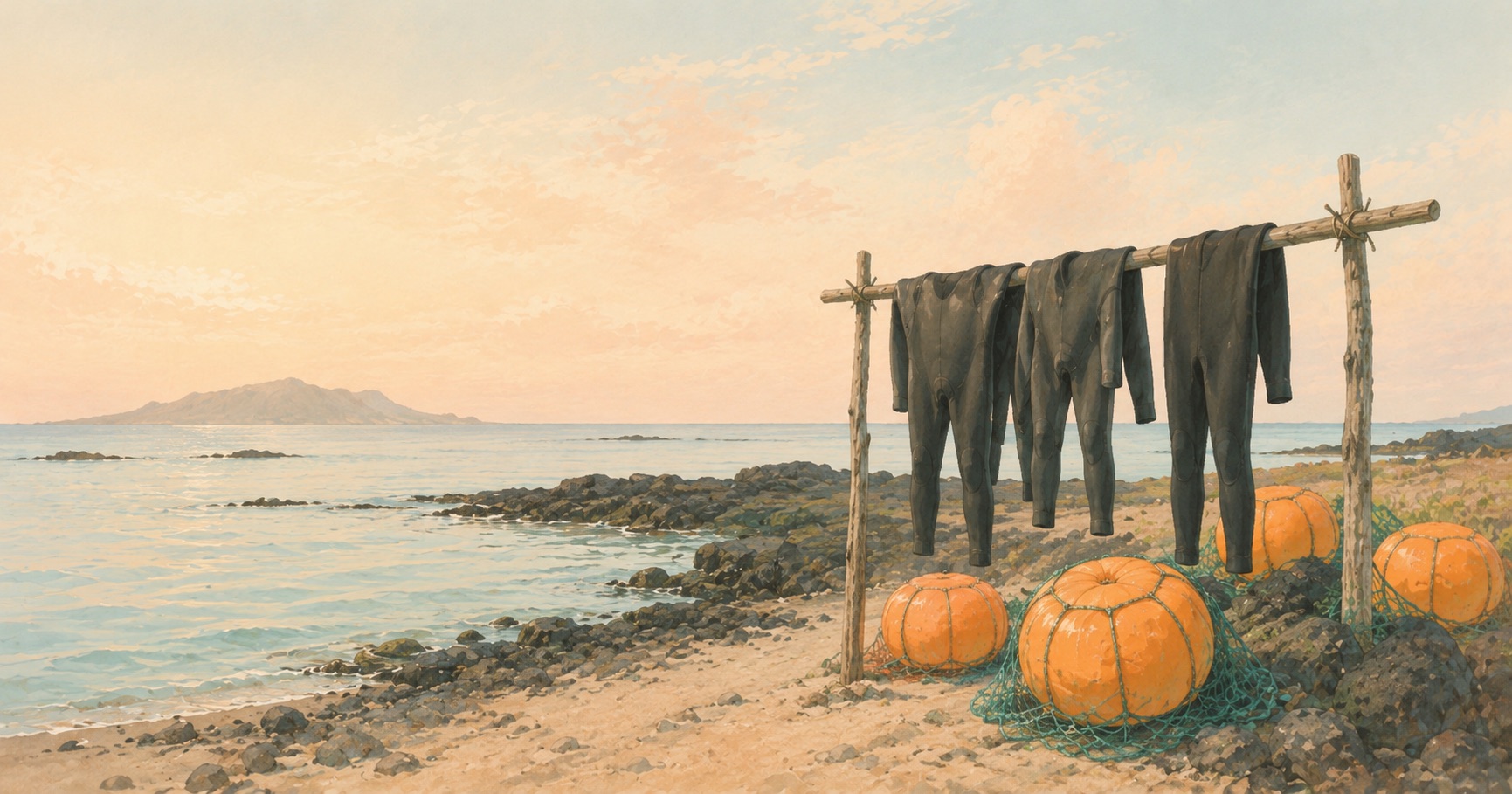
There are two layers. The lower layer is the law. The Fishery Resources Management Act, its enforcement decree, and provincial notices set closed seasons and size limits by species: conch is off limits through its summer spawning, abalone through its autumn spawning. These rules bind every fisher, not haenyeo alone.
The upper layer is the village. The cooperative and the haenyeo association read the state of the stock and set no-harvest periods longer than the law requires, or extend bans to catches the law does not cover. The opening days for miyeok, tot, and agar weed are set by the village, not by statute. They differ by cooperative, change from year to year, and are decided by agreement of the haenyeo association.
| Layer | Set by | Examples | If broken |
|---|---|---|---|
| Legal closed season | Statute and provincial notice | Conch in summer, abalone in autumn, sea cucumber in summer | Legal violation, fines |
| Size limits | Statute | No conch under 7 cm shell height, no abalone under 10 cm shell length | Legal violation |
| Village geumchaegi | Cooperative and haenyeo association | Bans longer than the legal season, extra catches covered | Community sanction |
| Haegyeong | Cooperative | The declared opening day for miyeok harvesting | Community sanction |
| Year of rest | Cooperative agreement | A full stop for a year when a stock collapses | Community sanction |
In haenyeo culture, the haegyeong is the day the miyeok harvest begins. The seaweed grows through winter and reaches full size in spring; cut earlier, it is thin, worth little, and the stock suffers. So the cooperative watches the crop, picks the day it has grown enough, declares the haegyeong, and the whole village enters the water at once. Cutting miyeok in secret before the haegyeong was counted among the gravest wrongs a villager could commit.
The haegyeong manages the resource, and it also manages fairness. When everyone starts on the same day, no one corners the crop by starting early. The strongest sanggun and the shortest-breathed halmang begin in the same sea on the same morning.
Money rides on the decision. While the sea rests, the divers' income shrinks. The village chooses rest anyway, because no one knows better than the divers that a sea emptied today has nothing left for next year.
The decision is made in the haenyeo association's meeting. The sanggun's opinion carries weight, but the vote belongs to everyone. When the room splits between resting and harvesting at least a little, the villages have mostly chosen rest, and the accumulation of those choices is why Jeju's waters still hold anything at all.
The exact dates and catches of each geumchaegi change every year by statute and by cooperative decision, so this article describes only the structure of the system.
Haenyeo set periods of not harvesting and keep them. A Sumbi dive does the same work from the opposite direction: a stretch of not using the phone is set in advance, and that is exactly how long the dive lasts. Sumbi supports the documentation and preservation of Jeju haenyeo culture.
Dive the length of one breath →A ban kept by one person alone is a loss. If everyone else harvests while one diver rests, her share simply disappears. So the cooperative has everyone start on the same day and stop on the same day. The rule draws its force not from punishment but from the fact that all keep it together.
A saying passes among the divers: what is left in the sea is still there tomorrow. The conch not taken today is larger next year. That one sentence, aimed straight at impatience, is what holds the geumchaegi up.
Bans that once held as pure custom are now being written into cooperative rules and law. As the number of divers falls and the communities that carried the customs weaken, the need to put the rules on paper has grown.
One line the sea taught us. What a haenyeo community does best is not harvesting but fixing the day to stop. A phone works the same way: decide the hours of not looking first, and the remaining hours grow easy.
This article is a cultural introduction based on published sources; figures reflect the survey dates listed in the references.
Scan the QR with your phone to open the install page.
 Sumbi
Sumbi