Walking the Jeju shore, you sometimes meet a low ring of stacked stone with a narrow opening and nothing inside. It is hard to guess what it was for. It is a bulteok: the place where haenyeo, Jeju's free-diving sea women, built a fire, warmed their bodies, and talked over the sea.
A bulteok is the round stone windbreak on the shore where haenyeo changed clothes before and after their sea work and warmed themselves at a fire. The stones were stacked in a circle against the wind with a fire pit in the middle, and the seats had an order, the place nearest the fire belonging to the sanggun, the top-rank divers. It served as the community's meeting hall, where diving knowledge and village decisions changed hands, until the rubber wetsuit and modern changing rooms left most bulteok unused. They survive today as quiet stone rings along the coast.
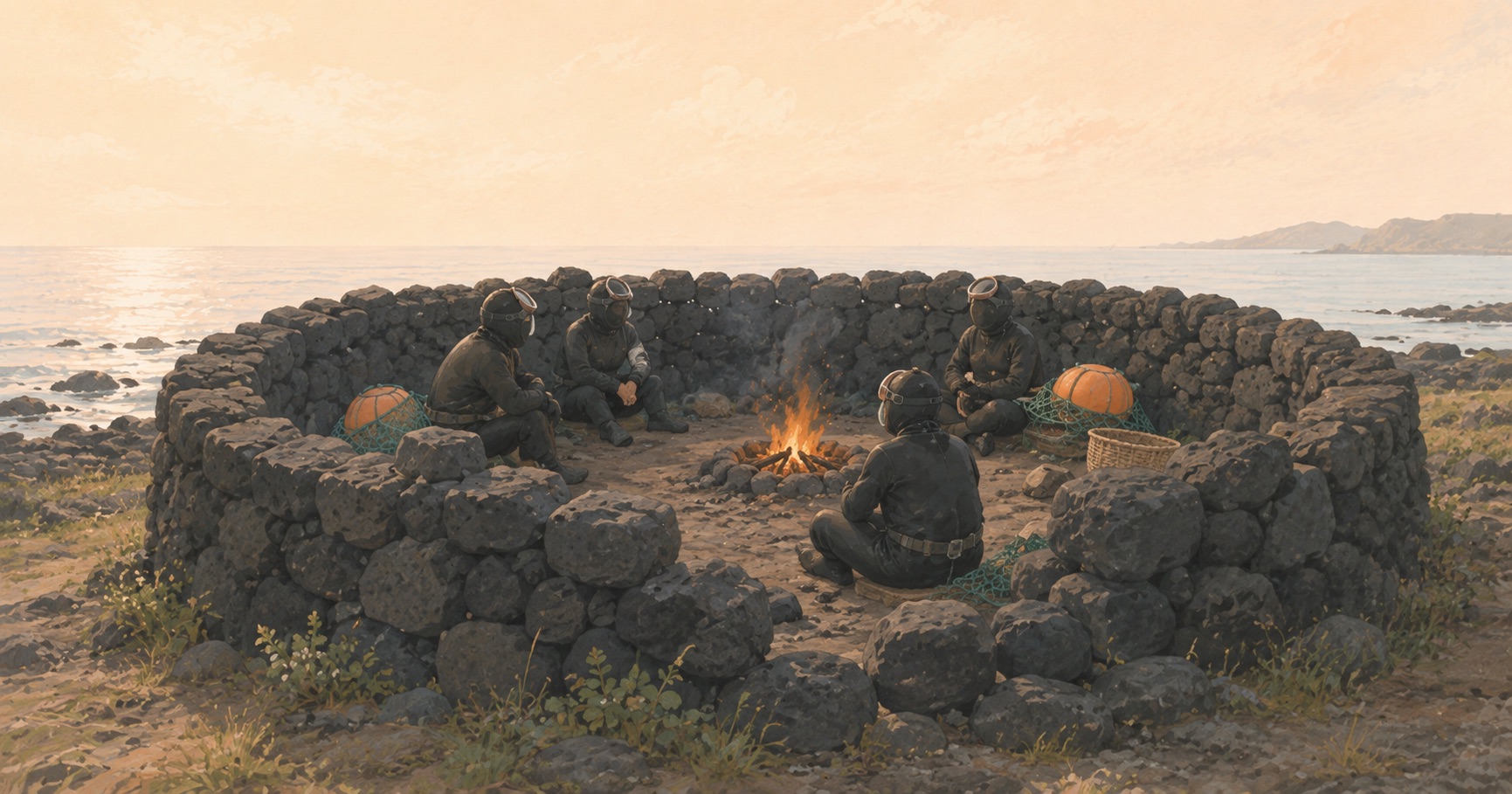
A bulteok is built of basalt stacked in a circle on the shore rocks or the coast near the village. The wall stands lower than an adult, with a narrow entrance cut on the sheltered side. In the middle is the fire pit, and the divers sit around it. There is no roof. The purpose was to block the wind and other people's eyes, and for that, one wall was enough.
Each village kept several. A wide fishing ground had one per section, and the bulteok in use shifted with the season and the wind. Each had its own name; in Hado-ri, bulteok bearing place names, such as the Bosikoji bulteok, still stand.
| Element | Detail |
|---|---|
| Material | Basalt stacked in a ring, no roof |
| Entrance | Narrow, cut on the side away from the wind |
| Center | The fire pit; the divers brought the firewood |
| Seats | Nearest the fire the sanggun, then the junggun, the hagun on the outside |
| Uses | Changing, warming up, cleaning the catch, meetings and teaching |
First, bodies warmed up. In the era of the cotton mulsojungi diving clothes, thirty minutes to an hour in the water was all the cold allowed, and the day was a cycle of diving and returning to the fire. The bulteok was what made the next round possible.
Second, people learned. The sanggun sat close to the fire and the hagun sat outside, and the hagun learned the sea by listening. Which rock hid abalone, how the current ran today, who had a close call and where: all of it passed around the fire. Half the craft of muljil was taught not underwater but at the bulteok.
Third, things were decided. The geumchaegi bans, the haegyeong opening day, the division of the fishing ground, the admission of a new member: the village's decisions began as talk at the bulteok. The haenyeo association was the organization; the bulteok was where the organization actually sat down.
The changing room is warm and comfortable, but the bulteok's second and third jobs, the teaching and the deciding, naturally thinned along with it. It is why the second hall of the Haenyeo Museum builds its account of community culture around a bulteok.
The bulteok was also a women's space. Men did not enter, and because clothes were changed there, even passing villagers turned their eyes away as a courtesy. It was where the money earned from the sea was counted, worries over children were shared, and hard marriages were aired, which is why bulteok stories run so thick through the divers' recorded oral histories.
Most surviving bulteok are unused relics, and some have been restored and maintained by their villages and the provincial government.
At the bulteok the divers sat together and shared the day's sea. Sumbi's Buddy comes from that seat at the fire: when a dive succeeds, and when a dive ends early, one trusted person hears about it. Sumbi supports the documentation and preservation of Jeju haenyeo culture.
Meet Sumbi →Several bulteok survive along the 4.4 km loop that begins at the Haenyeo Museum in Hado-ri, Gujwa-eup, the trail named for the whistling breath the divers make when they surface. The Bosikoji bulteok is among them, well-preserved rings stand along the shore, and information boards give each one's name and use.
The museum's second hall, devoted to haenyeo culture, is arranged around the bulteok. A recreated bulteok stands with the stories that circulated in it, alongside the jamsugut ritual and the divers' songs, the community life the fire once held together.
Fewer bulteok remain than have vanished. Road and breakwater works and coastal development pulled many down, and the survivors are slowly losing their shape as the stones slip. Bulteok still stand in shore villages across Jeju, but most carry no signboard, only stone, and are easy to walk past. A low round wall with one narrow opening is very likely a bulteok. Stepping in and sitting is fine; moving or stacking the stones is not.
One line the sea taught us. The haenyeo's craft was made half in the water and half at the bulteok. Putting the phone down works the same way: telling one person lasts longer than enduring alone.
This article is a cultural introduction based on published sources; figures reflect the survey dates listed in the references.
Scan the QR with your phone to open the install page.
 Sumbi
Sumbi