Line up photographs of haenyeo, Jeju's free-diving sea women, in order of era, and the clothing is the first thing the eye catches: a single layer of white cotton giving way to black rubber. Only the garment changed, and yet the hours of the work, the income it brought, and even the ailments of the body changed with it.
The haenyeo's working dress changed from the cotton mulsojungi and muljeoksam to the rubber wetsuit in the late twentieth century. In the cotton era, cold limited a session to thirty minutes or an hour, with long stretches spent warming up at the bulteok fire. After the wetsuit, divers could work three or four hours even in winter, and incomes rose. In exchange, the longer hours brought more decompression sickness and headaches, and lead weights joined the kit to overcome the suit's buoyancy.
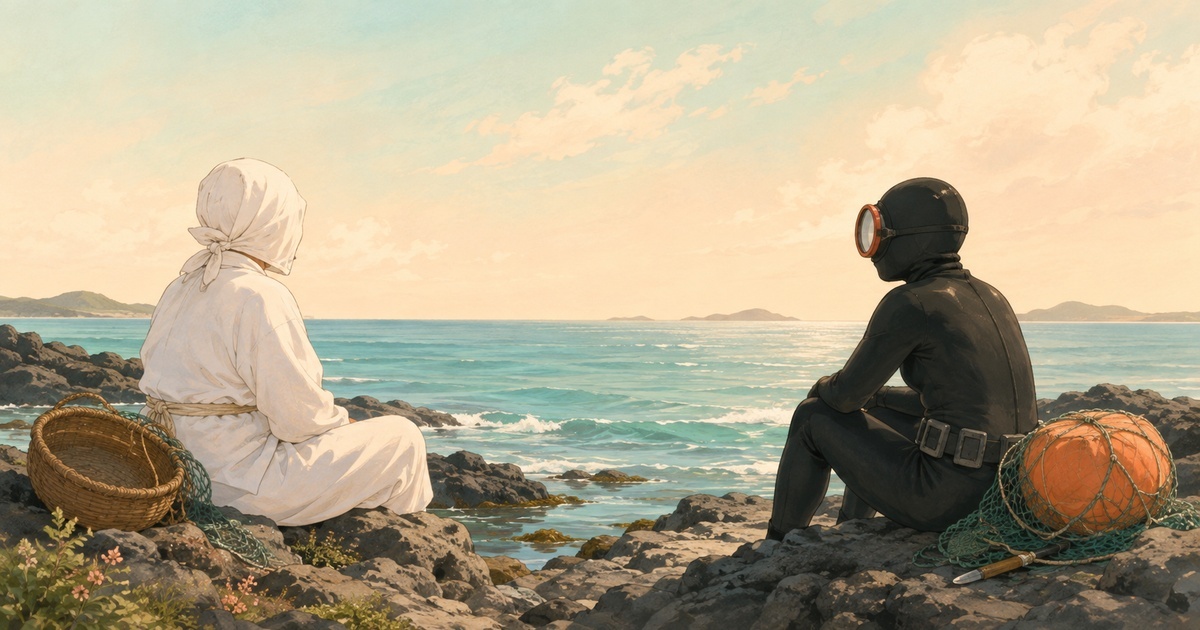
The mulsojungi was the haenyeo's old working garment, sewn from cotton. A single-layer suit with a strap over one shoulder and buttons or ties down the side, it was cut to adjust to the body and to be easy to change in and out of. Over it went a short jacket called the muljeoksam, and on the head a cloth hood called the kkaburi. The cotton was white or dyed dark, and most divers sewed their own.
The garment's problem was cold. One layer of cotton protects no one in seawater. So a diver worked thirty minutes to an hour, came out to warm herself at the bulteok, the stone windbreak with its fire, and went back in. The working day was short, and winter muljil was brutal.
| The mulsojungi era | After the wetsuit | |
|---|---|---|
| Dress | Cotton mulsojungi, muljeoksam, kkaburi | Black rubber wetsuit with attached hood |
| One session | Thirty minutes to an hour, cut short by cold | Three, four hours or more, winter included |
| Rest | Frequent breaks at the bulteok fire | Modern changing rooms; the bulteok falls out of use |
| Buoyancy | No extra gear needed | Lead weights required on a waist belt |
| Income | Small, capped by days and hours in the water | Larger, as the harvest grew |
| Health | Cold and hypothermia | More decompression sickness, headaches, joint pain |
The rubber suit reached Jeju in the late twentieth century, in most accounts the early 1970s, and spread fast. The usual telling has it arriving from Japan. At first the price kept it from everyone, but the gap in working hours and income was so large that within a few years nearly every diver had changed over.
The wetsuit changed muljil in two ways. First, time: with the cold solved, a diver could stay in the water for hours at a stretch. Second, season: winter diving became possible, and the sea was open the year round. Incomes rose, and with them the haenyeo's power to carry a household.
Able to stay longer, the divers stayed longer. Five or six hours of dives and ascents, repeated hundreds of times a day, brought a rise in decompression sickness, chronic headaches, and joint pain. The saying that a haenyeo lives on headache pills dates from this era. The cold of the cotton years had forced the divers to rest; the rubber suit made rest optional, and optional rest is the kind that gets skipped.
The garment reshaped the whole day. In the cotton era, a haenyeo dived briefly on the tide and returned to her fields; after the wetsuit, the hours in the water stretched until muljil filled most of the day. The old rhythm of sea work and field work in balance changed along with the clothes.
Jeju subsidizes the purchase of wetsuits for working haenyeo. The programs change from year to year, so the provincial and city notices are the authoritative source.
The wetsuit gave the haenyeo the power to stay longer, and the longer staying wore their bodies down, so the divers set their hours by rule rather than by endurance. Sumbi stands on the same footing: not the power to lock a screen, but the rule of keeping a time you chose. Sumbi supports the documentation and preservation of Jeju haenyeo culture.
Dive the length of one breath →The mulsojungi no longer enters the water, but it is recreated at haenyeo festivals and displayed at the Haenyeo Museum. Because its structure evolved to fit the diver's body and work so exactly, it is studied in its own right as folk dress.
The kkaburi head cloth gave way to the wetsuit's attached hood. In the cotton era, divers wrapped head and ears in cloth against the cold and the pressure of the water, and that old instinct survives in the fit of the rubber hood today.
The bulteok was where divers changed and warmed themselves. Modern changing rooms arrived with the wetsuit, and most bulteok fell silent, surviving now as stone rings along the coast, including several beside the walking trail that starts at the Haenyeo Museum.
One line the sea taught us. When staying longer became possible, what the haenyeo learned was not how to stay longer but how to decide, all over again, when to come out. A phone works the same way: precisely because it can be watched without end, the time has to be set.
This article is a cultural introduction based on published sources; figures reflect the survey dates listed in the references.
Scan the QR with your phone to open the install page.
 Sumbi
Sumbi