The equipment of a haenyeo, one of Jeju's free-diving sea women, is startlingly small. No tank, no machine. One thing that floats, one thing that holds, one thing that pries. Those simple tools have been in use for centuries, most of them under the same names the whole time.
The basic haenyeo tools are the tewak float, the mangsari net bag, the bitchang abalone blade, the kkakkuri hook, the jeonggehomi sickle, goggles, lead waist weights, and fins. The tewak went from hollowed gourd to foam, the goggles from the two-eyed jokswaenun to the single-lens wangnun, and the diving clothes from cotton to rubber, but the names and the jobs of the tools have not changed. An air tank has never been among them, from the beginning to now.
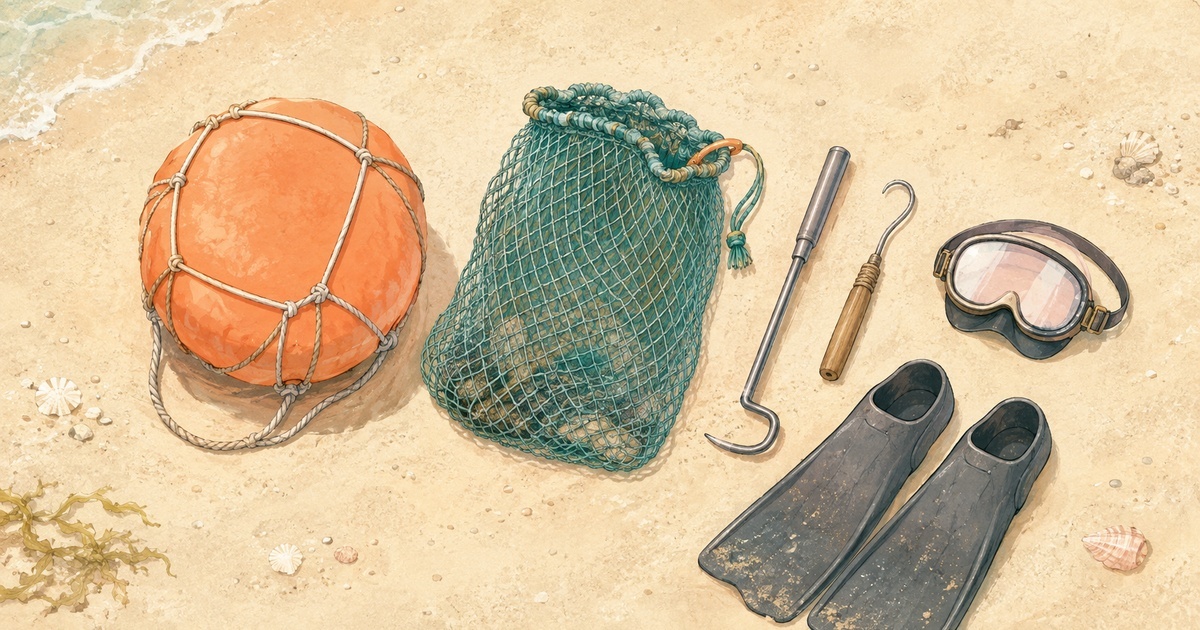
The tools fall into three groups: what works at the surface, what harvests below, and what the diver wears. All of it together is light enough for one person to sling over a shoulder and walk, which is why a haenyeo can enter the sea straight from the shore, no boat required.
| Tool | Use | Old material | Material now |
|---|---|---|---|
| Tewak | The float a diver rests on at the surface, catching her breath and marking her position | A hollowed-out gourd | Foam wrapped in cloth, bright orange |
| Mangsari | The net bag hung under the tewak that holds the catch | Net woven from silver grass | Nylon net |
| Bitchang | The flat iron blade that pries abalone off rock | Iron | Iron, with a wrist strap |
| Kkakkuri (homi) | The hook that pulls conch and octopus from crevices | Iron | Iron |
| Jeonggehomi | The sickle that cuts brown seaweed and agar weed | Iron | Iron |
| Goggles | For seeing underwater, introduced in the early twentieth century | Two-eyed jokswaenun | Single-lens wangnun |
| Lead weights | Waist weights that overcome the wetsuit's buoyancy | None (unneeded with cotton clothes) | Several lead pieces on a belt |
| Fins | Worn on the feet for propulsion | None | Rubber |
The tewak is the one thing a haenyeo can lean on at the surface. She dives, comes up, releases her long whistling breath, rests on the tewak with her arms over it, and dives again. Where the tewak floats is where the diver is working, which is why the modern version is a bright, unmissable orange. In the gourd era, a diver grew her own tewak in the field, and if the gourd cracked, muljil, the sea work, was over for the day.
The mangsari is the net bag tied beneath the tewak. Everything harvested goes into it between dives, so the two tools never separate. When the mangsari grows heavy, the day's share is full, and the diver comes out. Even when more could be taken, the size of the mangsari sets the day's limit.
Abalone clamp themselves to rock hard enough that fingers cannot move them. The bitchang is a flat iron blade slid into the gap to pop the abalone free in one motion. Fail on the first try and the abalone clamps down harder, so the move takes practice, and a short-breathed hagun rarely gets to use one. A strap loops the bitchang to the wrist, so a blade dropped underwater is not a blade lost.
The first exhibition hall of the Haenyeo Museum shows the real tools and how they changed, with recorded voices of working haenyeo linked to each one.
None of the haenyeo's tools does what the body cannot; each one only helps a little with what the body already does. Sumbi keeps to the same station: it does not lock the phone for you or watch over you, it simply floats beside the person keeping her chosen time, the way a tewak floats beside a diver. Sumbi supports the documentation and preservation of Jeju haenyeo culture.
Meet Sumbi →Until the early twentieth century, haenyeo read the seafloor with bare eyes. Goggles raised the harvest dramatically when they arrived: first the two-eyed jokswaenun, later the single-lens wangnun. Of all the tools, goggles are counted as the one that changed the work most.
The rubber wetsuit keeps a diver warm, but it floats. So several lead weights went onto the waist belt to bring her down. Fins arrived in the same period. As the kit grew, sessions grew longer, and so did the toll on the body.
The air tank never came, and not because the technology was missing. The legal definition of najam fishing is diving without breathing equipment, and the village cooperatives have held that line themselves. Haenyeo understand better than anyone that a tank could empty a stretch of sea in a day.
One line the sea taught us. The size of the mangsari is the size of the day. Time away from the phone follows the same rule: the limit is what was decided at the start, not what more could be managed.
This article is a cultural introduction based on published sources; figures reflect the survey dates listed in the references.
Scan the QR with your phone to open the install page.
 Sumbi
Sumbi