Most people who know anything about Jeju know the word haenyeo. Ask who actually counts as one, though, and the answers scatter. Is anyone who dives for shellfish a haenyeo? Do they exist only on Jeju? Are there men? The clearest place to start is the definition written into Jeju's own ordinance, and the fishing law behind it.
A haenyeo is a woman who harvests seafood by diving on her own breath, with no air supply of any kind. Jeju's ordinance defines her as a member of a fisheries cooperative who dives in village fishing grounds to gather marine products, now or in the past. Fishing done this way is called najam, literally bare diving; the work itself is called muljil; and as a livelihood practiced without equipment, it survives in only two countries, Korea and Japan.
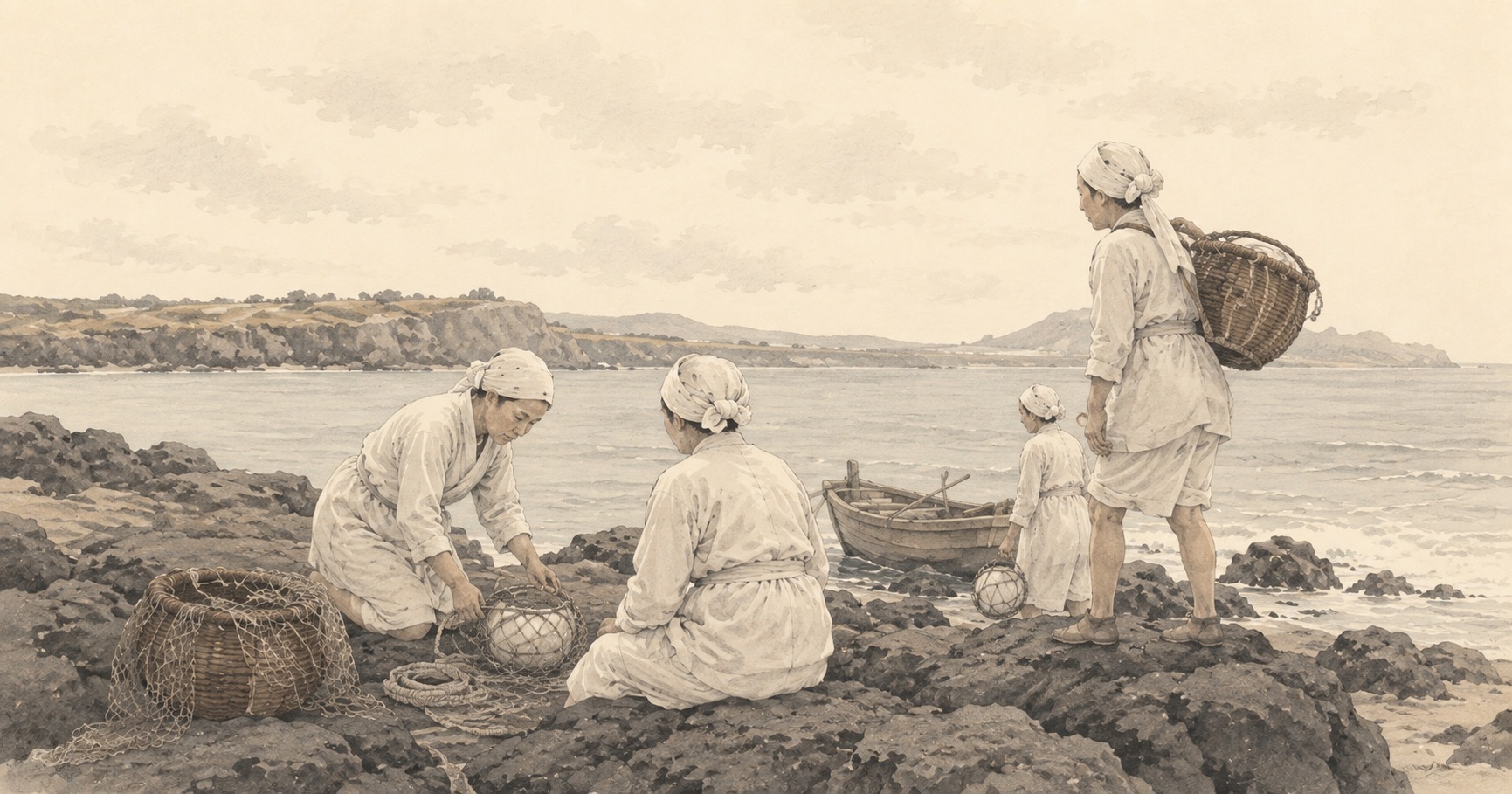
Jeju's ordinance on the preservation and transmission of haenyeo culture defines a haenyeo as a woman who belongs to a fisheries cooperative and dives in the village fishing grounds of Jeju to gather marine products, or who did this work in the past. Three conditions sit inside that sentence. She belongs to a village fishing cooperative, called an eochongye, and to the fisheries co-op above it. She harvests by diving in the village fishing grounds. And she is a woman.
The definition matters because it makes clear that haenyeo is a profession, not a hobby or a tourist experience. A haenyeo joins her village eochongye, harvests in an assigned fishing ground under shared rules, and sells through the cooperative. Diving well does not make someone a haenyeo. Joining the eochongye does.
| Haenyeo | Scuba diver | Commercial diver | |
|---|---|---|---|
| Equipment | Mask, wetsuit, fins. No tank | Tank and regulator | Surface-supplied air |
| Purpose | Harvesting seafood for a living | Recreation | Construction, salvage, survey |
| Affiliation | Village eochongye and fisheries co-op | Individual | Company or agency |
| Time under | One to two minutes per dive, repeated for hours | Tens of minutes per dive | Depends on the job |
Muljil is the Jeju word for the haenyeo's sea work, the whole business of going into the water and bringing food out of it. It means, roughly, water work, and it pairs with field work on land. Most haenyeo timed their muljil to the tides and spent the rest of the day farming, so the two words have always traveled together.
Najam is the administrative term. It means diving bare, and in fisheries law it names the type of fishing done by diving without any air supply. The law defines it separately for two reasons: to distinguish it from equipment diving, and to confine it to the village fishing grounds that each eochongye manages. Haenyeo are the defining practitioners of najam fishing.
People dive for food in many parts of the world. But a professional group that dives for a living every working day, without equipment, inside a lasting set of community rules, exists only in Korea and Japan. The National Archives of Korea puts it plainly: diving for a livelihood with no special equipment is found nowhere else.
No single cause explains it. Shallow coastal waters held valuable catch such as abalone and conch. Harvesting it settled into women's work. And that work came under the management of the eochongye, a community institution that carried the skills and the rules from one generation to the next. Where all three conditions met, the profession lasted. Jeju is where the divers were most numerous and the culture grew thickest.
When UNESCO inscribed the Culture of Jeju Haenyeo, it treated the diving technique, the community institutions, the rituals, and the songs as one culture, not as separate items.
A haenyeo stays in the sea exactly as long as her own breath allows, with no tank to stretch the limit. Sumbi borrowed its name and its rules from that way of working: one dive, one chosen length of time away from the phone, and nothing designed to hold anyone past it. Sumbi supports the documentation and preservation of Jeju haenyeo culture.
See the ocean Sumbi made →Yes. Haenyeo work the coasts of Busan and the Gyeongsang and Gangwon provinces, and many of those communities trace back to chulga muljil, the seasonal migrations that carried Jeju divers to mainland waters from the early twentieth century. Divers who settled there, and local women who learned from them, became today's mainland haenyeo. Korea's national designation of haenyeo as intangible heritage covers the whole country, not Jeju alone.
Joseon-era records describe male divers called pojakin who harvested abalone. The usual account is that crushing tribute quotas and military duties thinned their numbers until the work passed to women. A small number of men still practice najam fishing today, but the name haenyeo, and the culture around it, has been carried by communities of women.
The path runs through training and then through the village. Jeju has two haenyeo schools, and graduates who want to work must still be examined and accepted by an eochongye. Graduates say the same thing almost every time: the diving is learnable, but the harder gate is admission to the cooperative.
One line the sea taught us. A haenyeo works within the limits of her own body, not the reach of her tools. Putting the phone down starts the same way, not with a clever device, but with choosing a length of time that fits one breath of a day.
This article is a cultural introduction based on published sources; figures reflect the survey dates listed in the references.
Scan the QR with your phone to open the install page.
 Sumbi
Sumbi