For a haenyeo the sea is a workplace and, on the wrong day, the difference between life and death. So before the year begins, the divers greet the sea formally. The rites, called gut, were never mere superstition. They were how a community managed its fear together.
At the center of haenyeo ritual stand the yeongdeunggut, which greets the wind goddess Yeongdeung in the second lunar month to ask for a full harvest and safety, and the jamsugut, which the haenyeo association holds for safe diving. The Chilmeoridang Yeongdeunggut of Geonip-dong in Jeju City was inscribed by UNESCO as intangible cultural heritage in 2009, and beyond the communal rites, divers pray alone at small village shrines called haesindang. The rituals are faith, and they are also the community event at which the haenyeo association confirms the year's rules and its own bonds.
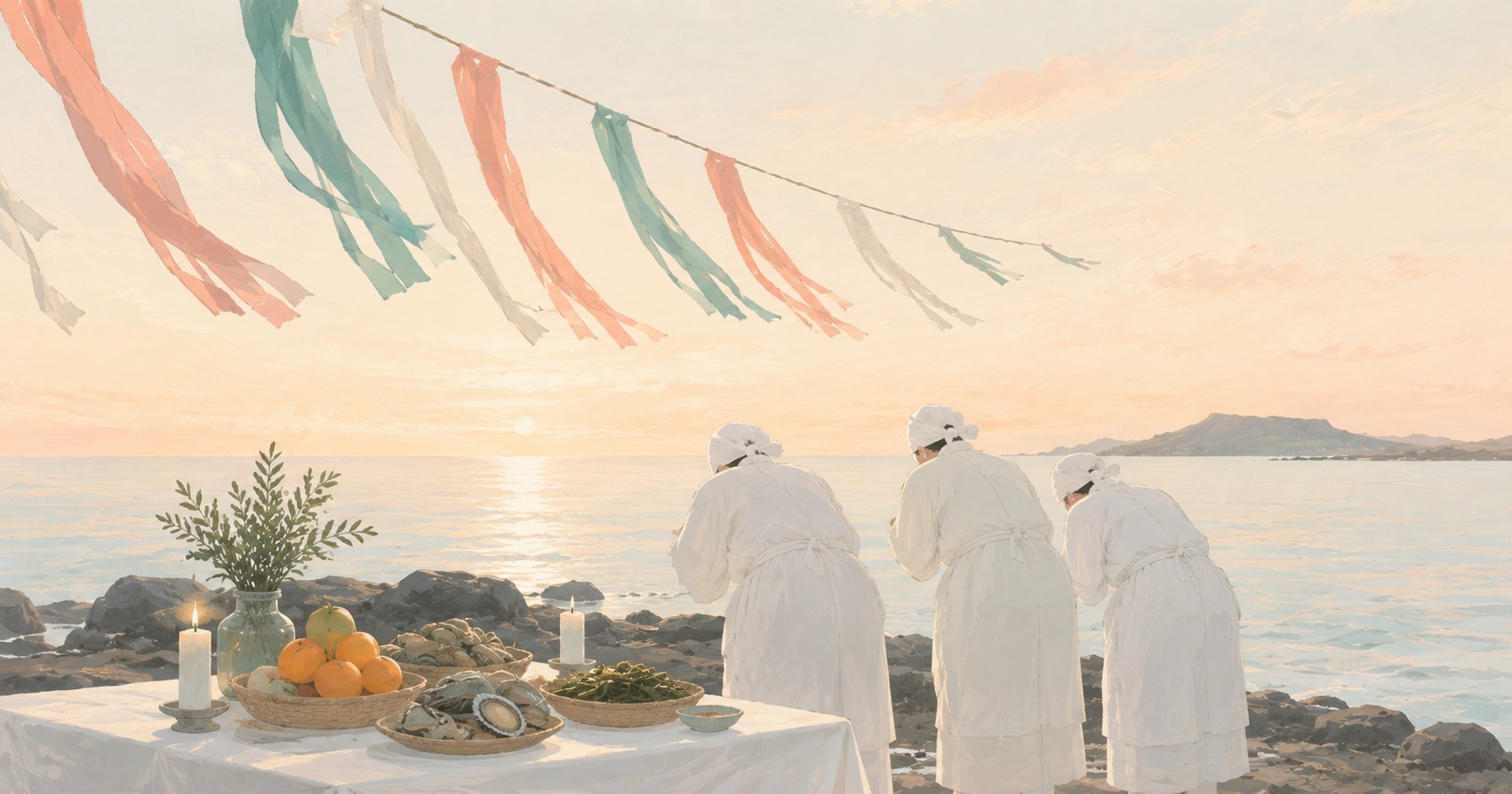
Jeju holds that the goddess Yeongdeung arrives on the first day of the second lunar month and leaves on the fifteenth. Yeongdeung is the deity of wind and the sower of the sea, believed to scatter the seeds of the year's shellfish and seaweed during her stay and so to decide the year's abundance. Villages therefore held a welcoming rite when she arrived and a farewell rite when she left, and together these are the yeongdeunggut.
At the heart of the yeongdeunggut stand the haenyeo. No one prayed harder for abundance and safety than the people who lived by the sea. In the sequence called ssideurim, the divers scatter millet over the water to ask for the seeding of the sea, the moment in the rite where its character as a haenyeo ritual shows most clearly.
| Rite | When | Held by | Asking for |
|---|---|---|---|
| Yeongdeunggut | First to fifteenth day of the second lunar month | The village, led by a simbang (shaman) | Abundance, the seeding of the sea, safety |
| Jamsugut | Differs by village, usually before the spring diving | The haenyeo association | Safe diving, a full harvest |
| Chilmeoridang Yeongdeunggut | First and fourteenth day of the second lunar month | Geonip-dong, Jeju City | The exemplary yeongdeunggut, UNESCO-listed |
| Haesindang prayers | Any time | Individual divers | The safety of family and self |
The jamsugut is the rite the haenyeo association holds itself. Where the yeongdeunggut belongs to the whole village, the jamsugut belongs to the divers. The date differs by village but usually falls in spring, before the serious diving begins. The divers pool the cost, prepare the offerings, and call a simbang to lead the prayers for a safe year.
The jamsugut is worship, and it is also a meeting. It is one of the rare days the whole association gathers in one place, so it doubles as the day the year's geumchaegi bans, the haegyeong opening day, and the rules of the fishing ground are confirmed, and new members are introduced. Managing fear together and setting the rules together happen on the same morning.
The yeongdeunggut held at the Chilmeori shrine in Geonip-dong, Jeju City, is the best preserved of Jeju's yeongdeung rites, and UNESCO inscribed it on the Representative List of intangible heritage in 2009, seven years before the Culture of Jeju Haenyeo. The full sequence in which divers, fishers, and villagers greet and send off the goddess survives intact, and the rite is designated national intangible heritage as well.
If the yeongdeunggut is the village's great occasion of greeting and farewell, the Chilmeoridang rite is the model in which the form survives whole. The divers' place in it is not small: it is haenyeo who scatter the millet in the ssideurim and haenyeo who stand at the front in the yowang-maji. The people who live by the sea greet the sea first. That is the order of things.
The rites follow the lunar calendar, so the solar dates shift every year. Anyone hoping to watch should check the announcements of the Chilmeoridang Yeongdeunggut preservation society.
Before the diving began, the haenyeo greeted the sea, because a frightening thing is not begun alone but with hearts gathered. A Sumbi dive begins the same way, with a Buddy told at the start, and ends with a sumbisori on surfacing. Sumbi supports the documentation and preservation of Jeju haenyeo culture.
Hear Sumbi's sumbisori →On the village shore stand small shrines called haesindang. Divers stop there before going out, or when something weighs on the family, and pray alone. It is not a grand rite but an everyday faith, and one such shrine stands along the coastal trail that begins at the Haenyeo Museum.
The deity of the sea is called Yowang on Jeju, the island's form of the Dragon King's name. The yowang-maji sequence in the jamsugut and yeongdeunggut opens a path to Yowang and offers greetings, and nowhere is the divers' attitude toward the sea more visible.
As the divers grow fewer, more villages can no longer hold a jamsugut; the rite takes money and people. Unlike the Chilmeoridang Yeongdeunggut, preserved by UNESCO and the state, the village jamsugut is thinly recorded, and the Haenyeo Museum has been filming the ones that remain.
One line the sea taught us. Before a frightening task, the haenyeo bowed first and gathered together. Putting the phone down draws strength the same way: less from a grand resolution than from telling one person at the start.
This article is a cultural introduction based on published sources; figures reflect the survey dates listed in the references.
Scan the QR with your phone to open the install page.
 Sumbi
Sumbi