Say haenyeo song and most people think of one refrain: Ieodo sana, ieodo sana. The phrase is widely known; when and how the song was actually sung, and where Ieodo is, much less so. The best way in is to return the song to the place it was made for.
Ieodo Sana is the refrain of the work song haenyeo sang to the rhythm of the oars while rowing out to distant fishing grounds. One singer leads the verses and the rest answer with the refrain, and the lead verses were never fixed: each singer filled them, on the spot, with her own sea and her own troubles. Ieodo is a legendary island believed to lie somewhere south of Jeju, at once a resting place beyond this hard life and the place where those who never returned from the sea were said to have gone. The haenyeo song is designated intangible heritage of Jeju Province and preserved.
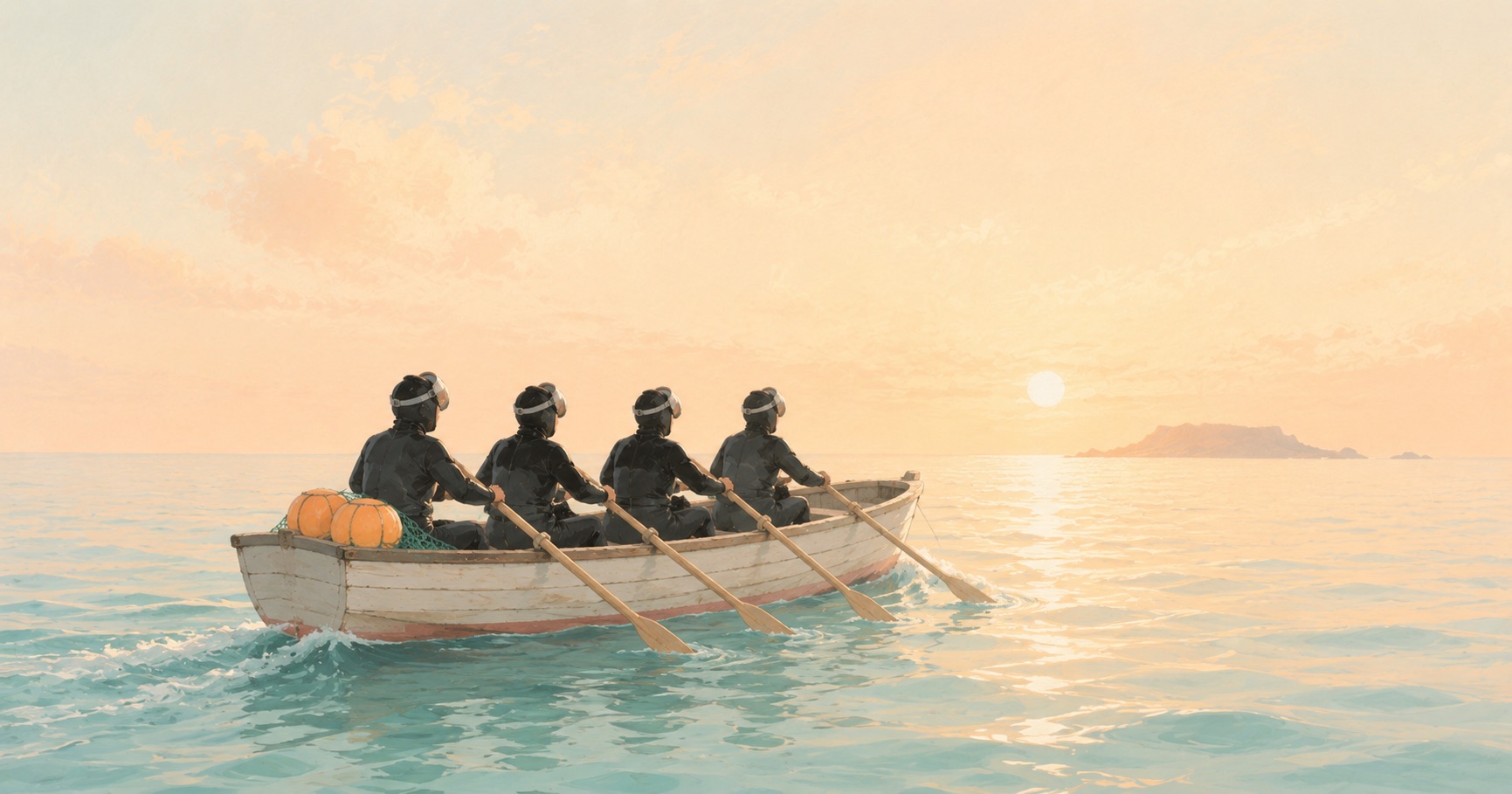
The haenyeo song is not sung in the water. When the fishing ground lay far out, the divers went by boat, pulling the oars together, and the song was the work song that kept the strokes in time. On Jeju it is also called the haenyeo's oar-pulling song. The song was the rhythm, and the rhythm was the song.
The form is call and response. One diver with a strong voice or a strong stroke leads the verse, and the rest answer with a refrain such as ieodo sana. The lead verses have no fixed text. The day's sea, the singer's own lot, a hard marriage, a husband lost, a child left ashore: all of it entered on the spot. It is why the same song is a different song in every mouth.
| Element | Detail |
|---|---|
| When sung | Rowing out to the fishing ground and back |
| Form | Call and response, one leading and the rest answering |
| Refrain | Ieodo sana and variants, fitted to the stroke of the oars |
| Lead verses | Improvised, no fixed text, filled with the singer's life |
| Rhythm | Regular, matched to the pull and push of the oar |
| Status | Designated intangible heritage of Jeju Province as the haenyeo song |
Ieodo is a legendary island believed to lie somewhere in the sea south of Jeju: invisible from land, unreachable by boat, and yet a place, it was said, where hardship ends. At the same time it was the place where those who went to sea and never came back were said to have gone. A haven and a grave share the one name.
For haenyeo the island meant something particular. Muljil, the sea work, always ran alongside death, and when someone asked where a lost companion, a lost husband, a lost son had gone, Ieodo was the answer. To row toward that same sea singing a refrain that carried the island's name was a way of steadying fear with song.
Today the name Ieodo also belongs to a real submerged rock south of Jeju and the ocean research station built on it, but the Ieodo of the song is not a position on a chart. It is a place in the mind.
The song was not only women's. A male boatman sometimes rowed with the crew, and then the verses passed between the men and the women. But the stories in the lead verses were mostly the divers' own. A song sung by the people doing the diving could hardly be otherwise.
The full lyrics are not reproduced in this article. The lead verses were improvised, so no definitive text exists, and the transcribed versions belong to those who collected them. The transcriptions can be read in the Haenyeo Museum's materials and Jeju's intangible heritage records.
The haenyeo song was never sung alone: one voice led and the others answered. A Sumbi dive keeps the same shape, with a Buddy who knows when it begins and a sumbisori when it ends, closer to a shared stroke than to solitary endurance. Sumbi supports the documentation and preservation of Jeju haenyeo culture.
Hear Sumbi's sumbisori →Motorboats arrived, more villages began diving straight off the shore, and the oars went still. When the work the song was fastened to disappeared, the song left daily life with it. Ieodo Sana today is sung on stages and at festivals, not over the water.
Jeju designates the haenyeo song as intangible heritage and maintains recognized holders and trainees. A preservation society around Gujwa-eup learns and performs the song, and it can be heard at haenyeo festivals and at rites such as the yeongdeunggut.
Musicians have arranged Ieodo Sana and folded its refrain into new songs, and films and dramas about the haenyeo reach for it often. Gone from its first place, the rowing boat, the song keeps finding others.
One line the sea taught us. Rowing out toward a sea they feared, the haenyeo did not grit their teeth alone; they sang together. Putting the phone down lasts longer the same way, keeping time with one other person rather than clenching through it.
This article is a cultural introduction based on published sources; figures reflect the survey dates listed in the references.
Scan the QR with your phone to open the install page.
 Sumbi
Sumbi