Hearing that the haenyeo, Jeju's free-diving sea women, work without oxygen tanks, most people want to know two things: how deep they go, and why no tanks. The first question has an answer in numbers. The second has an answer that numbers cannot give.
A haenyeo typically works at 5 to 10 meters, holding her breath around a minute per dive, while a sanggun, a top-rank diver, works beyond 10 meters and stays close to two minutes. Over three to seven hours a day she repeats the cycle of dive and ascent dozens to more than a hundred times. There are no tanks because the legal definition of najam fishing is diving without breathing equipment, and, before the law ever said so, because the haenyeo community has long known that taking only a breath's worth is what leaves the sea standing.
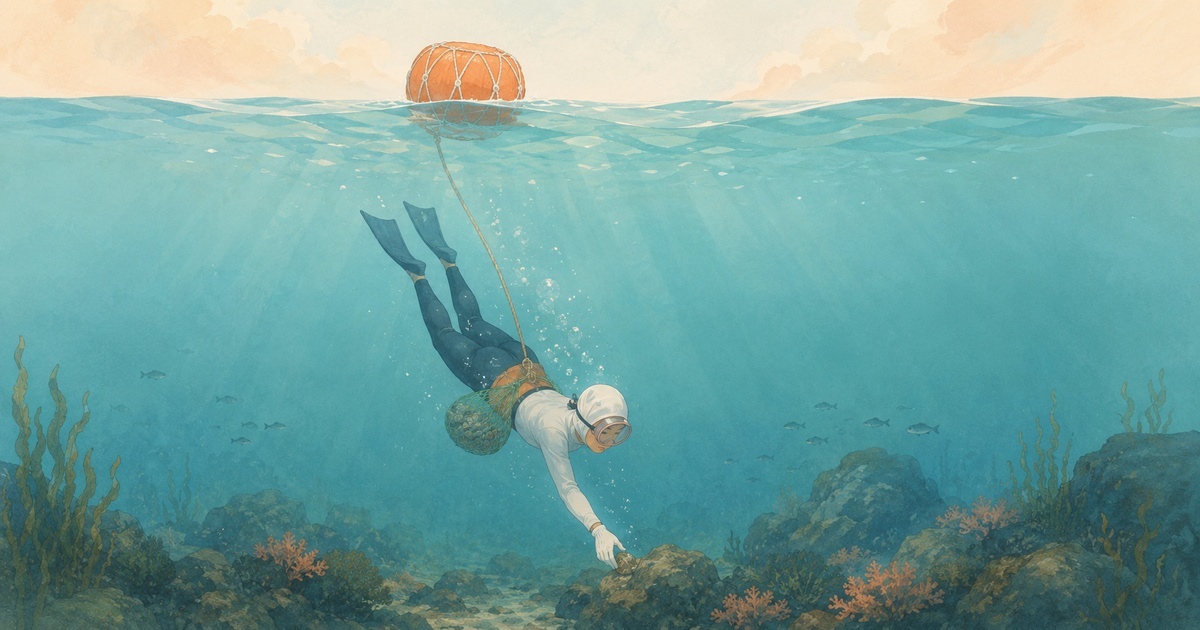
By the Haenyeo Museum and various surveys, haenyeo mostly work at 5 to 10 meters. A sanggun passes 10 and works around 15 meters, with a rare few approaching 20. A hagun, a junior diver, works the shallows at 3 to 5 meters. Depth tracks rank, but it also tracks the day's condition: the same diver goes deeper on some mornings than others.
The time is shorter than the depth suggests. One dive runs about a minute, and even a sanggun rarely passes two. Descending and ascending eat most of it, so the actual harvesting at the bottom lasts a few dozen seconds. In those seconds she reads the underside of a rock, pries the abalone, drops it in the mangsari net, and turns for the light.
| Depth | One dive | Notes | |
|---|---|---|---|
| Hagun | 3 to 5 m | 30 seconds to 1 minute | Mostly sea urchin and seaweed |
| Junggun | 5 to 10 m | About 1 minute | Conch and abalone |
| Sanggun | 10 to 15 m and beyond | 1 minute 30 to 2 minutes | Large abalone, far grounds |
| A full day | Set by the tide | 3 to 7 hours, repeated dozens to 100-plus times | Governed by season and weather |
First, the law. The najam fishing that haenyeo practice is defined as harvesting by diving without an air supply, and equipment diving for harvest is not permitted in the village fishing grounds the cooperatives manage. The moment a tank goes on, it is a different fishery.
Second, the resource. With a tank, one person can sweep the bottom for tens of minutes at a stretch, and the abalone and conch of the shallows would be gone within a few years. The limit of one breath is itself the brake on overharvesting. It is exactly what UNESCO pointed to in calling the haenyeo's way of harvesting sustainable.
Third, the community. The moment one diver uses equipment, the others' shares vanish. The whole division of the sea, sanggun in the deep, hagun in the shallows, the halmang-badang held for the elderly, stands on a single shared condition: everyone dives on her own breath.
What a haenyeo fears is not the depth but mulsum, the water breath. Near the limit of the breath, a large abalone comes into view, and the thought arrives: just one more moment. In that moment the body finally inhales underwater, and that inhale is mulsum. A diver who takes it in does not come back. Haenyeo teach that greed is what makes a diver swallow mulsum, and they count knowing the limit of one's own breath as the first skill of the work.
Diving accidents mostly come from time, not depth. Haenyeo training points the same way: it teaches surfacing on time before it teaches going deep.
A haenyeo carries no tank and stays only as long as her own breath allows. A Sumbi dive works the same way, a chosen stretch from ten minutes up to four hours, with nothing built in to hold anyone past it: coming up on time is what success means. Sumbi supports the documentation and preservation of Jeju haenyeo culture.
See the ocean Sumbi made →Hundreds of pressure changes a day take a toll. Chronic headaches, ear and sinus pain, and joint pain are common among haenyeo, and all of them grew after the wetsuit stretched the hours. Jeju supports divers' medical costs and operates treatment facilities for diving-related illness.
Winter water is cold even through rubber, and inside the suit summer is hot. After a session the diver needs time in the changing room to warm up or cool down, the role the bulteok fire once played.
Breath shortens with age. Every sanggun one day becomes a junggun and, in time, moves to the halmang-badang, the shallow water reserved for the eldest. Which is why the community assigns each diver not a target depth but the sea that fits her breath.
One line the sea taught us. The first skill of a haenyeo is not going deep but turning for the surface before the breath runs out. Time away from the phone can be measured the same way, not by how long you endure but by whether you come back when you said you would.
This article is a cultural introduction based on published sources; figures reflect the survey dates listed in the references.
Scan the QR with your phone to open the install page.
 Sumbi
Sumbi