Stand on the eastern shore of Jeju Island and you may hear something like whistling drifting in from the water. Hoo-ee, long and thin, slowly fading. That is the sound of a haenyeo, one of Jeju's traditional free-diving sea women, coming up from her work and letting go of the breath she has been holding. Nearly everything about haenyeo culture is folded into that one breath.
Sumbisori is the whistle-like sound a haenyeo makes when she surfaces from a dive and releases her held breath in one long exhale. It is a breathing technique: after about a minute underwater, the body needs to vent built-up carbon dioxide fast and pull in fresh air, and exhaling hard through pursed lips makes the air whistle. When the sound carries across the water, it means a diver has come up safely. The app Sumbi takes its name from this sound.
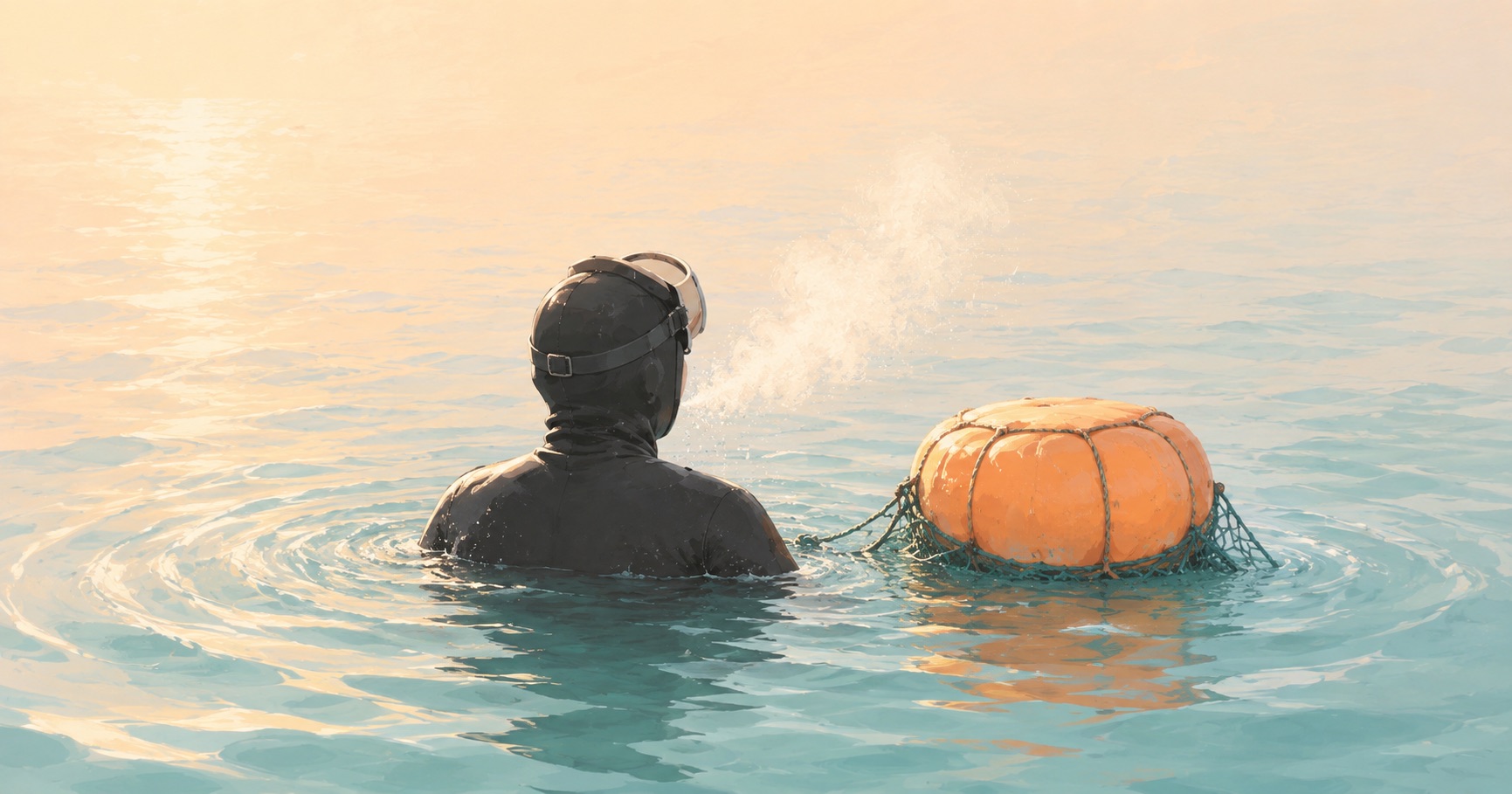
Near a stretch of coast where haenyeo are doing muljil, their sea work, it can sound as if several people are whistling at once. It is not a short burst. It is a long hoo-ee that stretches out and then fades. A single haenyeo repeats dives of about a minute dozens of times in a session, so for the hours a crew is out, the sound over the water almost never stops.
The sound itself is breathing. Working underwater on a held breath leaves the body loaded with carbon dioxide and short on oxygen. On surfacing, the diver has to push the air out of her lungs all at once and draw new air in, and when she exhales hard through pursed lips, the air rushes through a narrow opening and whistles. It is not a song and not a signal. It is a physiological reset before the next dive.
| Stage | What the body is doing | What the haenyeo does |
|---|---|---|
| Before the dive | Filling the lungs with air | Holds her tewak, the gourd float she rests on at the surface, takes a deep breath, and goes under |
| During the dive | Oxygen falls, carbon dioxide builds | Harvests for about a minute, surfaces when the breath runs short |
| At the surface | Carbon dioxide must be vented quickly | Exhales long through pursed lips, and this is the sumbisori |
| Recovery | A few breaths restore oxygen | Rests on the tewak, then dives again |
Materials at the Haenyeo Museum describe it simply as a whistling sound, but heard in person, no two divers sound quite alike. The sumbisori of a top-rank diver returning from deep water tends to run long and low, while the sound after a shallow dive is short. Veteran haenyeo say they can tell who has surfaced, and roughly how deep she went, by the sound alone.
Sumbisori joins two words: sumbi and sori, the Korean word for sound. The origin of sumbi is not settled. The most widely shared reading is that it means emptying the breath, from the act of letting go of the air a diver has been holding. Another reading points to the Jeju verb sumbida, to hold the breath and slip underwater, in which case sumbisori is the sound made after going under and coming back up. Either way, holding a breath and releasing it live together inside one word.
Depending on the village and the generation, variants such as sumbijil-sori and sumbijil are also used. Korean dictionaries list sumbisori as Jeju dialect, glossed roughly as the whistling sound haenyeo make as they come up from their sea work.
The word haenyeo guard against most is mulsum, the water breath. When greed says one more, just one more, and a diver pushes past the limit of her breath, the body finally inhales underwater. That inhale is mulsum. A diver who takes in mulsum does not come back from the sea. A sumbisori means the diver did not take it, which is why the sound is also a sound of relief.
A saying passed among haenyeo holds that greed is what makes a diver swallow mulsum. Knowing the limit of your own breath is the first skill of muljil.
In Sumbi, the sound described above marks the end of every dive. Put the phone down for the time you chose, surface, and a long "Hoo-ee" greets you, the way it greets a diver who came up before the water breath. Sumbi supports the documentation and preservation of Jeju haenyeo culture.
Begin your first dive →Along the shores of villages with many working haenyeo, such as Hado-ri and Sehwa-ri in Gujwa-eup or Onpyeong-ri in Seongsan-eup, the sound can be heard while muljil is under way. Crews go out on the morning or afternoon tide, so the hours differ from village to village. The courteous way to listen is from a distance on shore, without approaching divers at work or entering the village fishing grounds.
The Haenyeo Museum in Hado-ri keeps recorded oral histories and field recordings of haenyeo sounds, and the Sumbisori Trail, a 4.4 km loop named after this sound, begins at the museum. The path passes a bulteok, the stone windbreak where haenyeo warm up and talk, and on some days divers can be seen working off the shore below.
Sumbisori also survives on tape. The museum and a number of documentaries have captured the breathing of working haenyeo, and the sound is being archived alongside haenyeo songs as part of Jeju's sound heritage. As the number of divers falls, hearing it live grows harder each year, and the recordings matter more.
One line the sea taught us. A haenyeo stays only as long as her breath allows, then surfaces and lets it go in one long exhale. Time away from the phone can work the same way: stay for the length you chose, then come up.
This article is a cultural introduction based on published sources; figures reflect the survey dates listed in the references.
Scan the QR with your phone to open the install page.
 Sumbi
Sumbi