Bring up the haenyeo, Jeju's free-diving sea women, and one question arrives on schedule: does Japan not have the same thing? It does. Japan has the ama, and the two cultures resemble each other closely. Look closer, though, and the differences turn out to be the more interesting part.
Jeju's haenyeo and Japan's ama are the world's only two professional cultures of harvesting the sea on a held breath, without oxygen equipment. They share bare-breath diving, community management of the resource, and transmission centered on women. They differ in that some ama dive deep using a boat and rope while the haenyeo swim out and dive from a tewak float on their own, that male ama formally exist, and that the community rulebook runs denser on the Jeju side. The entry on UNESCO's Representative List is the Culture of Jeju Haenyeo.
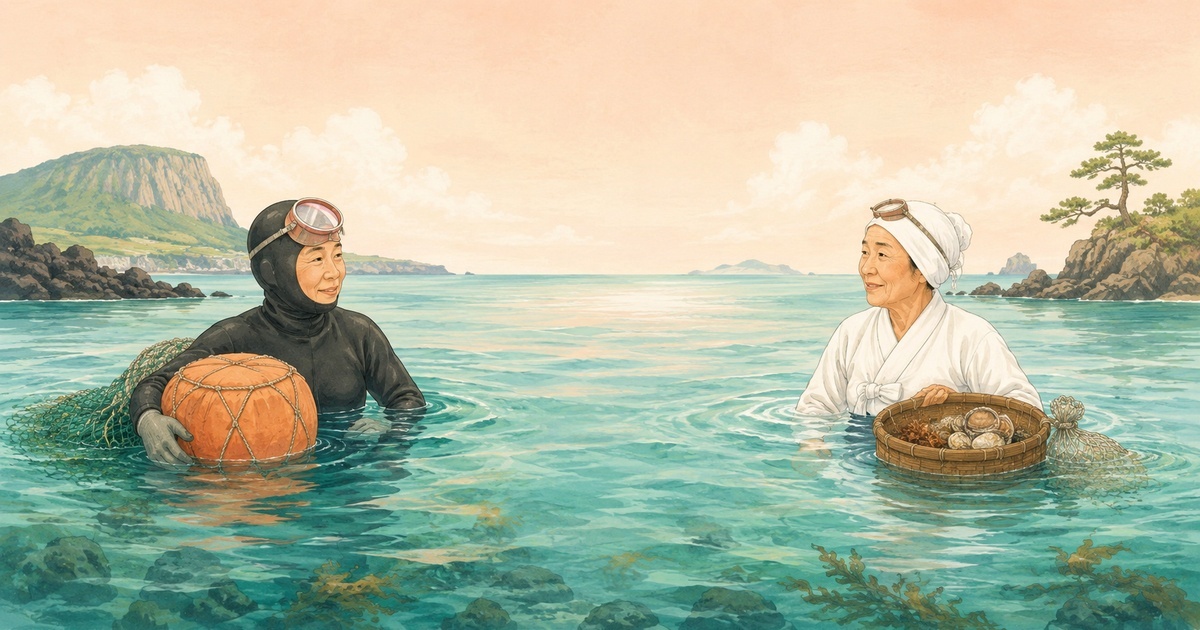
Ama is the Japanese name for divers who harvest abalone, conch, sea urchin, and seaweed on a held breath, without equipment. Communities survive along several coasts, including Chiba and Ishikawa prefectures, with the largest concentration around Toba and Shima in Mie prefecture. Most ama are women, but male ama exist as well, written with a different second character in Japanese.
The ama tradition is old in its own right. Diving women appear in ancient Japanese texts and poetry, and the work continued in fishing villages into the modern era. Like the haenyeo, the ama now face aging and shrinking numbers, and Japan has designated the ama diving techniques of the Toba and Shima region as national folk cultural property.
| Jeju haenyeo | Japanese ama | |
|---|---|---|
| Diving method | Swims out holding a tewak float and dives from it unassisted | Shore-based diving, plus a boat-and-rope method for deeper water |
| Depth | Usually 5 to 10 meters, deeper for top-rank divers | Similar from shore; the rope method goes deeper |
| Gender | Women; the word haenyeo itself means sea women | Mostly women, with male ama recognized |
| Clothing | Cotton mulsojungi in the past, black wetsuits today | White isogi in the past, wetsuits also used today |
| Community | Eochongye and haenyeo associations, with rules such as halmang-badang and closed seasons | Harvest rules and rest days set by fishing cooperatives |
| Ritual | The jamsugut and yeongdeunggut rites for the sea | Shrine worship of sea deities and protective talisman marks |
| Heritage status | UNESCO listing, national intangible heritage, FAO agricultural heritage | Japanese national designation as important folk cultural property |
The method, above all. Both dive with no tank, on nothing but their own breath, one to two minutes at a time, dozens of times a day, and both exhale audibly at the surface. The ama's whistling surface breath, called isonageki in some regions, works on the same principle as the whistling breath the haenyeo release when they surface.
Resource management runs parallel too. Both cultures set harvest seasons and size limits and leave the young shellfish in the water. The rules come from the fishing community, not from each diver's judgment. That shared discipline is why both traditions have lasted for centuries, and it is precisely what UNESCO and the Japanese government each singled out for recognition.
First, the boat and the rope. In the ama method called funado, a partner on the boat, often the diver's husband, holds a rope while the ama rides a weight down fast and is hauled back up. A haenyeo may ride a boat out to distant grounds, but the dive itself is always her own: unassisted, from the tewak, on her own power.
Second, gender. Haenyeo is a women's name for a women's profession, and the haenyeo associations are women's institutions. Among the ama, women are the majority but men hold a formal place.
Third, the density of the rulebook. The fine grain of Jeju's community rules stands out: halmang-badang, the custom of reserving the calm shallows for elderly divers, the duties that come with sanggun rank, even the seating order at the bulteok fire. It is the layer of haenyeo culture UNESCO dwelt on longest.
The two cultures have met, not only mirrored each other. Jeju divers worked Japanese waters during the migration era of chulga muljil, and exchange visits between haenyeo and ama communities continue today.
In different seas, the haenyeo and the ama reached the same conclusion: take a breath's worth, and only as much as leaves the sea able to give again. Sumbi carries that conclusion into the hours spent with a phone, and its name comes from the sumbisori of Jeju. Sumbi supports the documentation and preservation of Jeju haenyeo culture.
Dive the length of one breath →Shallow coastal water held valuable catch, harvesting it settled into women's work, and a village institution managed that work and passed it on. Korea and Japan are where all three conditions held at once. Remove any one, and diving stays an activity instead of becoming a profession with a culture around it.
Written in Chinese characters, haenyeo and the Japanese ama are the same two characters, sea and woman. Some see Japanese influence in the Korean word's spread, but it has long since settled into Korean, and the name on the UNESCO list is Haenyeo. Jeju elders still use the older words jamnyeo and jamsu alongside it.
Both cultures are aging and shrinking. The ama population has fallen steeply over recent decades, and Japanese regions are responding with experience tourism and archiving projects, much as Jeju is. The live question for both is not which tradition fades first, but which finds a way to continue first.
One line the sea taught us. In both seas, the divers learned when to surface before they learned to hold on longer. The order matters with a phone as well: decide when to come up, then dive.
This article is a cultural introduction based on published sources; figures reflect the survey dates listed in the references.
Scan the QR with your phone to open the install page.
 Sumbi
Sumbi